Temple of Diana, Mérida (Templo de Diana)
Dedicated to the Imperial Cult, the Templo de Diana (Extremadura, Spain)

The Temple of Diana (Templo de Diana) in Mérida is despite its name dedicated to the Imperial cult. Built in the first century during the reign of Augustus in local granite, it stands impressively in what was the old Roman forum.
Along with the Teatro Romano, Anfiteatro (Amphitheatre), Puente Romana (Roman Bridge), Circo Romano (Roman Circus), Acueducto de los Milagros (Aqueduct of the Miracles), Museo Nacional de Arte Romano (MNAR) and Arco de Trajano, it makes up part of the Archaeological Ensemble of Mérida, a UNESCO World Heritage Site.

History
Constructed in the 1st century BCE during the reign of Emperor Augustus, the temple stood at the heart of the city's forum, serving as a central point for both religious ceremonies and civic life.
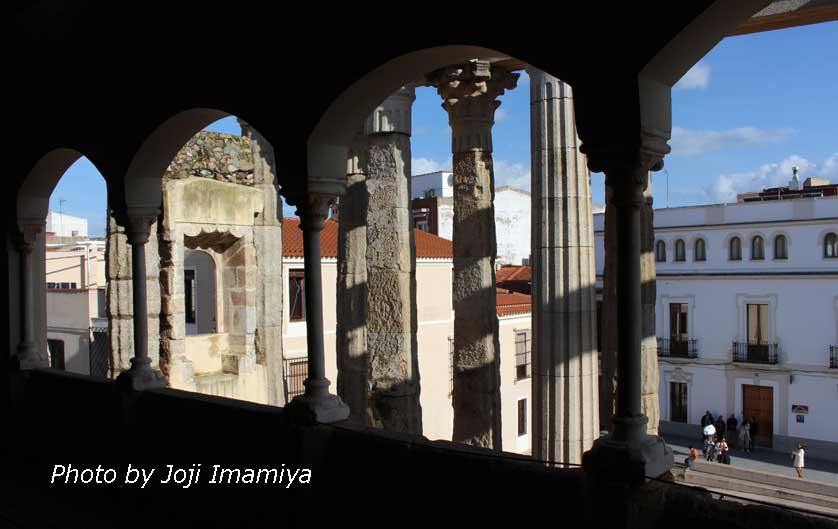
During the Visigothic and Moorish periods, the structure saw various adaptations. In the 16th century, the powerful Conde de los Corbos (Count of Los Corbos) built a Renaissance palace within the temple's colonnade.


Architecture
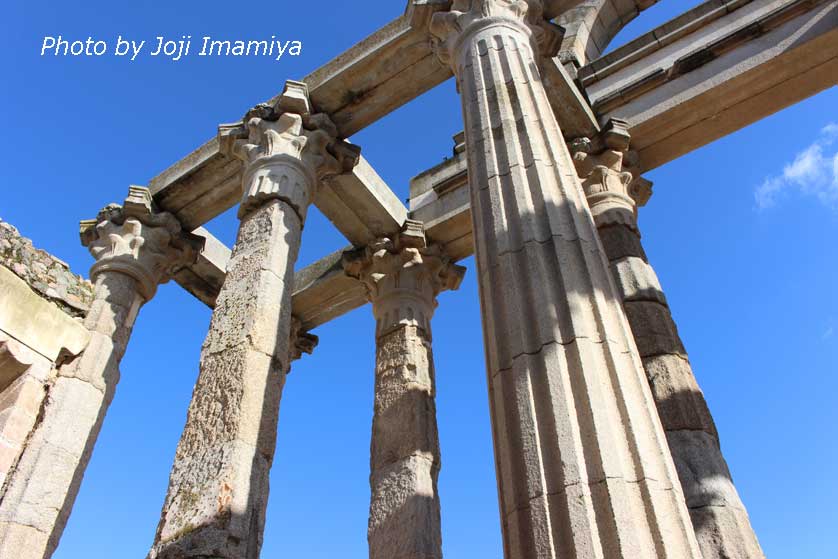
Constructed primarily from local granite, the columns are fluted, with ornately carved Corinthian capitals. The podium and steps were made of stone blocks, and show the advanced Roman engineering techniques of the time.
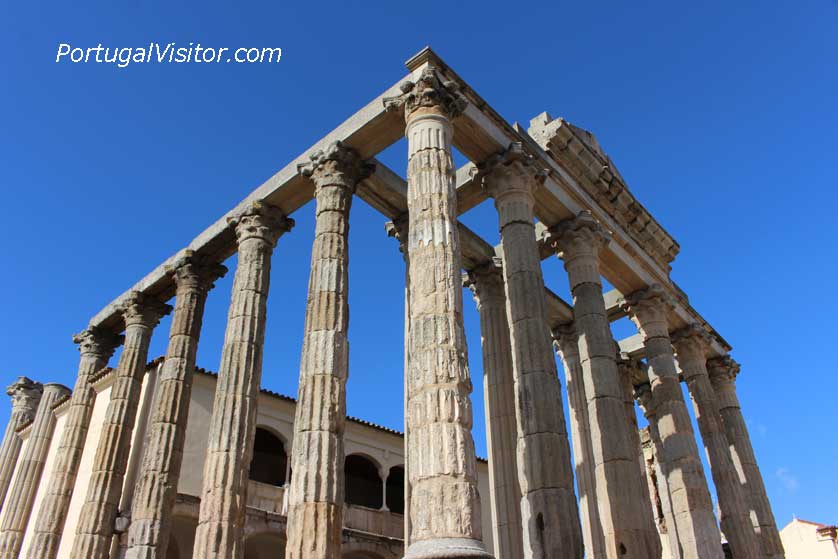
The temple is rectangular and oriented east-west, with a portico of six granite columns across the front. The peristyle (surrounding colonnade) includes 17 columns, many of which remain upright and in situ. The temple's exceptional state of preservation is due to the fact that the structure served as the foundation and framework of the Renaissance palace of the Count of Corbos, some parts of which are also still preserved.
In addition, marble slabs from the temple's paving, as well as the walls that delimited it, are also still in a good state of preservation, as are the two pools that flanked the building.

Pórtico del Foro Municipal de Augusta Emérita
A short walk away is the Pórtico del Foro Municipal de Augusta Emérita. It was erected around the middle of the 1st century as a copy of the Forum of Augustus in Rome. The enclosing walls have large niches in which statues of the imperial family as well as gods and myths linked to the history of Rome and the family of Augustus were placed. Visible on the walls are medallions of Jupiter-Ammon and Medusa.

Accommodation
The city of Mérida has a wide selection of hotels, guest houses and pensions.
The Hotel Ilunion Mérida Palace in Plaza de España offers an outdoor pool and rooftop terrace in a restored 15th century palace.
The four-star Hotel Ilunion Las Lomas slightly outside the center has an outdoor pool, a bar and restaurant.
The Hotel Velada Mérida is also four-star. Facilities include a pool and cafe-bar.
Other places to stay in this lovely city include the luxury Parador de Mérida once an 18th century convent. Enjoy the traditional-style inner courtyard and beautiful gardens and dine at the hotel restaurant.
Hotel Cervantes is a budget two-star property for travelers on a tighter budget.
See a listing of hotels in Mérida

Access & Hours
Address: C. Romero Leal, 06800 Mérida, Badajoz
An interpretation center has been set up within the palace, focusing on the importance of the building in Roman times and its subsequent uses. Information panels, projections, and original and replica pieces provide an insight into the history of this temple dedicated to imperial worship.
Interpretation Center Fees
Individual Ticket: €3
Entrance to the Complete Monumental Complex (Theater-Amphitheater, Alcazaba, Circus, Moreria, Crypt of St. Eulalia, Mithraeum-Columbarium House, Amphitheater House, and Temple of Diana): €16 (regular ticket) - €8 (reductions*)
*Young people up to 17 years old, youth card holders, students up to 25 years old, people over 65 or retired, people with disabilities, and members of large families.
Free admission: children up to 12 years old, MECENAS members, researchers, and Mérida residents.

Mérida Station is at the junction of two lines: east-west between Badajoz and Madrid and south to Sevilla Santa Justa via Zafra. It has rail connections to Alcázar de San Juan, Almendralejo, Badajoz Station in Badajoz, Cabeza del Buey, Madrid-Chamartin, Cáceres, Don Benito-Villanueva de la Serena, Zafra, Sevilla and Plasencia.
From Badajoz Station to the west there are trains to Entroncamento in Portugal, with connections from there to Lisbon and Porto.
The bus station in Merida is across the Puente Lusitania on the opposite bank of the River Guardiana.
Maps

Gallery