Travel Basics - Portuguese Language
Portuguese is the world's 4th major language spoken by an estimated 250 people, with 189 million of them in Brazil.
The major Portuguese-speaking nations: Angola, Brazil, Cape Verde, East Timor, Guinea-Bissau, Mozambique, Portugal and Sao Tome and Principe originally agreed to unify the language in 1991.
Portuguese Language - Useful Phrases
The Basics
yes sim
no não
Where is? onde é
How much? quanto custa
Ticket bilhete
Thank you obrigado
Toilet casa de banho
food comida
drink bebida
water água
Excuse me/I'm sorry desculpe
What time is it? Que horas são
Wait a moment espere um momento
Meeting People
Hello olá
Goodbye adeus
My name is .. chamo me
What is your name? como se chama
How are you? como está/como estás
Fine bem obrigado
I'm from England sou da Inglaterra
I'm from Scotland sou da Escïcia
I'm from America sou dos Estados Unidos
I'm from Wales sou do País de Gales
I'm from Ireland sou da Irlanda
I love you amo-te
General
Excuse me, where is the subway/underground? onde é a estação do metro?
Where is the train station? onde é a estação?
train comboio
bus stop paragem
Take me to the airport please leve-me para o aeroporto faz favor
Do you have any vacancies? tem algum quarto livre?
I'm lost estou perdido/a
Draught beer (large) uma caneca
Beer uma cerveja
Big grande
Small pequeno
post office correios
Emergencies
Call the police! chame a polícia!
Call an ambulance! chamen auma ambulancia!
I want to contact the embassy queria contactar com a minha embaixada
Stadium Stuff
football futebol
The European Championship Campeonato da Europa
Goal o golo
Penalty um penalty
Corner kick um canto
Red card cartão vermelho
Yellow card cartão amarelo
Referee o árbitro
Goalkeeper o guarda-redes
F%ck off! vai á merda!
Numbers
1 um/uma
2 dois/duas
3 tres
4 quatro
5 cinco
6 seis
7 sete
8 oito
9 nove
10 dez
15 quinze
20 vinte
30 trinta
40 quaranta
50 cinquenta
60 sessenta
70 setenta
80 oitenta
90 noventa
100 cem
200 duzentos
1000 mil
Months
Months meses
January janeiro
February fevereiro
March marco
April abril
May maio
June junho
July julho
August agosto
September setembro
October outubro
November novembro
December dezembro
Food & Drink
A table for......, please Uma mesa para......, se faz favor
A beer, please Vou tomar uma cervejar
Can I see the menu, please? Posso ver o menu, por favor? A ementa, se faz favor
I am a vegetarian Sou vegetariano/a
The bill, please A conta, sefaz favor
boiled cozido
fried frito
fish peixe
grilled grelhado
sea bass robalo
octopus with rice arroz de polvo
fried cod bacalhau
meat carne
roast beef carne assada
veal vitela
duck with rice arroz de pato
turkey peru
olive oil azeite
salt sal
milk leite
grapes uvas
cheese queijo
beer cerveja
wine vinho
house wine vinho da casa
ice-cream gelado
cheers! saúde!
Portuguese Influence on Other Languages
The Portuguese language has had a significant influence on several other languages throughout history, particularly through colonization, trade, and cultural exchange.
Spanish
Portuguese and Spanish share a close linguistic relationship due to their common origins as Romance languages. While they have distinct grammatical and pronunciation differences, Portuguese has influenced the vocabulary of Spanish, particularly in terms of maritime and nautical terms, as well as culinary terms.
Brazilian Portuguese
As the official language of Brazil, Portuguese has influenced the indigenous languages spoken in the country. It has also absorbed words from African languages brought by enslaved populations during the colonial period. Additionally, due to Brazil's cultural influence, Brazilian Portuguese terms and expressions have made their way into other languages, especially in the entertainment industry.
African Languages
Portuguese colonization in Africa left a lasting impact on the local languages of the regions under Portuguese rule. In countries like Angola, Mozambique, Cape Verde, Guinea-Bissau, and São Tomé and Príncipe, Portuguese introduced loanwords, grammatical structures, and language contact phenomena. These influences can still be observed in the respective Creole languages developed in these regions.
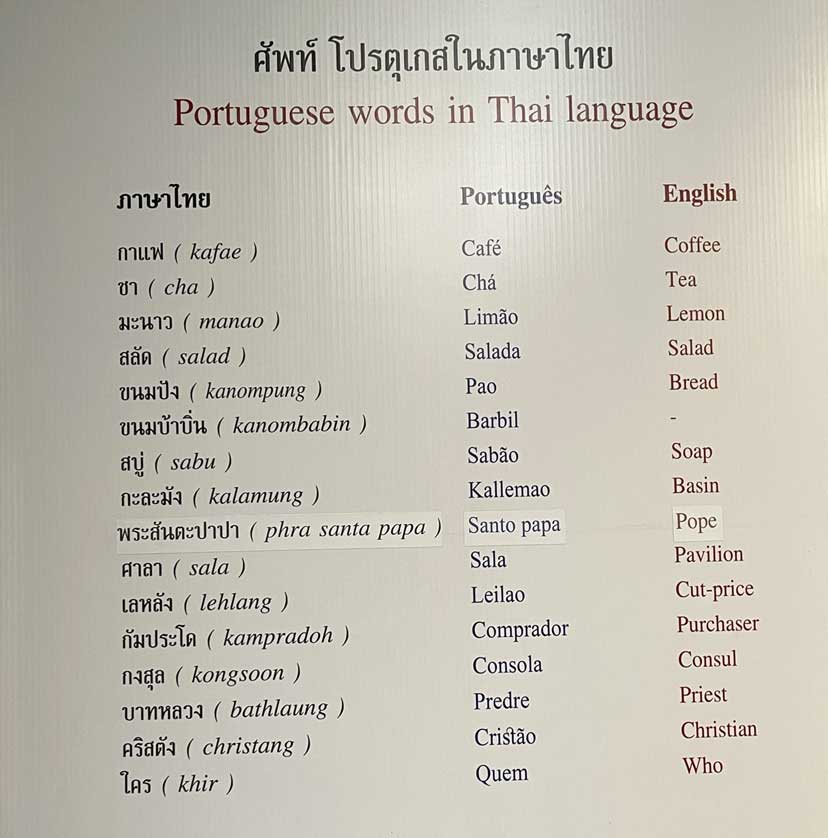
Asian Languages
The Portuguese established trading posts and colonies in various parts of Asia, such as Macau, Goa, Malacca, Siam (Thailand) and East Timor. Consequently, Portuguese vocabulary and cultural concepts became embedded in local languages. For example, Macanese Creole, spoken in Macau, incorporates Portuguese words and grammar alongside Cantonese and Malay.
In some Indian regions, Konkani and Daman and Diu Portuguese creoles reflect the Portuguese influence.
Portuguese missionaries and traders arrived in Japan during the 16th century. This encounter led to the introduction of Portuguese loanwords into the Japanese language. Many of these loanwords relate to Western technology, religion, and culture. Examples include anjo (angel), pan (bread), and beranda (veranda), derived from the Portuguese words anjo, pão, and varanda, respectively.
English
English has absorbed several loanwords from Portuguese, particularly in the context of exploration, trade, and cuisine. Words such as "cobra," "mosquito," and "embark" have Portuguese origins. Additionally, culinary terms like "tomato," "potato," "chocolate," and "banana" were introduced to English through Portuguese influence.
These examples illustrate the diverse ways in which the Portuguese language has influenced and enriched other languages across the globe. Whether through colonization, trade, or cultural exchange, Portuguese has left its linguistic mark, demonstrating the interconnectedness of languages and the ongoing evolution of linguistic diversity.
Language Resources