Pontevedra Guide
Pontevedra (Galicia, Spain)
Pontevedra is the capital of the province of Pontevedra in Galicia, northwestern Spain. 30 km north of Vigo this charming, relaxed city has a population of over 80,000 people.
The city is situated on the Ria de Pontevedra, the northernmost of the Rías Baixas, deep-water, sunken estuaries that mark this part of the Atlantic coast. The River Lérez enters the sea here.
Pontevedra has over the years become one of the best places to live in Spain. The city center is now largely pedestrianized and has won several awards for its urban planning as well as international attention for its low carbon emissions and quality of family-friendly life.
As in Vigo, two languages are generally spoken by the city's inhabitants, Galician (Galego) which is close to Portuguese and Spanish.


History
The name of the city - "Old Bridge" - refers to the first bridge the Romans built over the River Lérez.
During the medieval period between the 12th and 15th centuries, Pontevedra grew as a commercial town, fishing port and ship-building center located on the Camino Portugués (Portuguese Way) path of the Camino de Santiago to Santiago de Compostela.
Indeed, Christopher Columbus' flagship on his first voyage to the Americas, the carrack Santa Maria, initially named La Gallega ("The Galician"), was built in Pontevedra.
Later the silting of the estuary by the River Lérez meant that the city lost much of its earlier importance as a port and led to a period of decline and depopulation.
Pontevedra rebounds in the 19th century as a center of Galician culture and language. The coming of the railway compensated for the loss of its port.
The Nationalist government under Franco made nearby Vigo a tax-free zone in 1947 which spurred growth in Pontevedra's rival to the detriment of the provincial capital.
Since the late 1990s the establishment of a university and the city's progressive, eco-friendly policies have spurred both cultural and economic growth.


Attractions
The main attraction in Pontevedra is its well-preserved Centro Histórico centered around the superb 16th century Basilica of Saint Mary Major. The 16th century church acts as the city's cathedral and major architectural monument.
The 18th century Igrexa da Virxe Peregrina (Church of the Pilgrim Virgin) is another symbol of the city. Its design mirrors the shape of a scallop shell, the main emblem associated with the Camino de Santiago pilgrimage.
Other historic churches include the Convento de Santa Clara, once a convent for the nuns of the Order of Poor Clares and the 14th century Convento e Igrexa de San Francisco. The church is Gothic in architectural style while the convent, rebuilt in the 18th century is Baroque.
Another Baroque church is the Igrexa de San Bartolomeu constructed in the 17th century by the Jesuits with a superb, though solemn, facade.
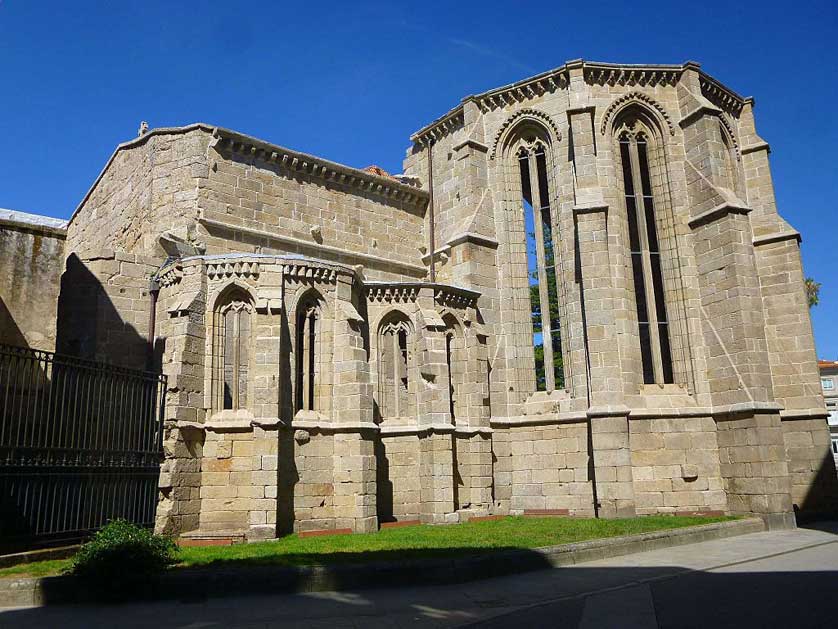
The Ruínas de San Domingos are the ruins of a once 13th century monastery and are part of the Pontevedra Museum.
The list of non-religious historic buildings is long and impressive. The Casa de las Campanas ("House of the Bells" / Casa das Campás) is probably the oldest of them. The three-story building now serves as a meeting and seminar room for the Pontevedra campus of the University of Vigo.
A pazo is a type of Galician traditional house similar to a manor house and there are several of note in Pontevedra. The Pazo de Castro Monteagudo close to Plaza de la Leña once belonged to the wealthy José de Castro Monteagudo. The house now exhibits collections of art primarily painting, archaeology, as well as Roman and pre-Roman silverware.
The Pazo de García Flórez is adjacent and dates from the 18th century. It is now part of the Pontevedra Museum and holds a diverse collection of exhibits including furniture, jet jewelry from Compostela, navigational instruments, pottery and sculpture.
The Pazo Barbeito aka Casa de las Caras or the "House of the Heads" was the former home of one D. Juan Barbeito y Padrón in the 16th century. Busts of heads protrude from the walls on the upper floor to give the house its name. The house also has a large orchard and garden.
The City Hall (Casa Consistorial) was inaugurated in 1880 and is the work of architect Alejandro Sesmero (1843-1913). This fine building is done in the French style, popular at the time. Sesmero was also the architect of the Mendoza Palace, the Deputación Provincial de Pontevedra and the Mercado Municipal as well as several other civic buildings in the wider area.

Museums
There are some excellent museums in the city. The Pontevedra Museum incorporates six different sites.
These are the Pazo de Castro Monteagudo, Pazo de García Flórez, the Fernández López House, Sarmiento (the former Baroque College of the Society of Jesus), the Castelao Building inaugurated in 2013 and the ruins of the San Domingo Convent (Archaeology Museum).
The Centro de Interpretación das Torres Arcebispais (CITA / Archiepiscopal Towers Interpretation Centre) is a modern, underground museum dedicated to the former Archiepiscopal Towers, a pair of fortified towers that hosted kings and bishops as they journeyed to and from Santiago de Compostela.

Bridges
Several impressive bridges span the river in Pontevedra.
The oldest is the medieval Ponte do Burgo built over the original Roman foundations sometime in the 12th century. Located on the Caminho Português, the bridge is adorned with scallop shells, symbols of the pilgrimage.
The most recent is the tied-arch Ponte das Correntes completed in 2012. Its name means "Currents" as it is here that the waters of the river meet the ria. This elegant, modern bridge has two lanes in each direction and two cycle paths. Separate covered pedestrian bridges are also on each side.
Ponte da Barca dates originally from a metal bridge built in 1905 and replaced by a concrete bridge in 1950. It connects Pontevedra to the district of Poio.
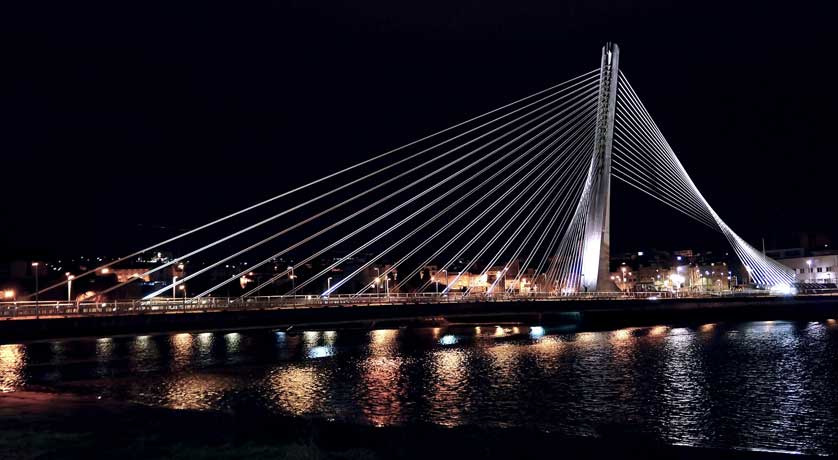
The cable-stayed Ponte dos Tirantes (Tirantes Bridge) opened in 1995 and was constructed along with the nearby Pazo da Cultura de Pontevedra. The latter is a congress hall which houses an auditorium with a capacity of over 700 people, a restaurant, press rooms, an exhibition hall, and several lecture rooms.

Tourist Offices
The Municipal Tourist Information Office is located at Praza de España, 1 in the old town in the Casa Consistorial. Tel: 986 090 890.
The Rias Bajas Tourist Office is housed in the Palacete das Mendoza (Mendoza Mansion), a 19th century villa and the first private residence in the city to receive running water. Plaza de Santa María, s/n 36002 Pontevedra; Tel: 986 804 100.

Marín
Nearby Marín is home to the Naval Military Academy (Escuela Naval Militar, ENM) and some spectacular beaches. These include beaches at Aguete, Lapamán, Loire, Mogor, O Santo and Portocelo. The resort town is 8 km south west of Pontevedra.

Accommodation
Pontevedra has a fine selection of places to stay to suit all budgets.
The Parador de Pontevedra is a wonderful 4-star hotel set in a historic 16th-century palace.
Rias Bajas is a three-star property close to the old city.
Other places to stay include the four-star Galicia Palace on Avenida de Vigo, which offers comfortable rooms with free WiFi.
Hotel Madrid is a one-star budget option near the A Fonte Dos Nenos.
See a listing of hotels in Pontevedra



Access
Trains from Pontevedra run south to Vigo and to other destinations in Spain.
There are Celta trains twice a day connecting Vigo to Campanhã Station and São Bento Station in Porto. The Celta train also stops at Valença Station in Valença, Viana do Castelo Station and Nine. The service is operated by Comboios de Portugal.
At Vigo-Guixar Station, the terminus of the line, it is possible to transfer to RENFE regional trains to Pontevedra, Santiago de Compostela, A Coruna and also take trains to Ourense, Madrid-Chamartin and Barcelona-Sants.
There are buses from Pontevedra to Ourense, Santiago, Cambados, Lugo, O Grove, Tui and Madrid.
Air
Vigo's Peinador Airport (VGO), 9 km east of the center, is the nearest airport to Pontevedra. It has domestic flights to Tenerife, Gran Canaria, Madrid and Barcelona. The Vitrasa bus 9A connects Vigo's Vigo-Urzáiz Station to the airport. The L8, L16 and L24 buses run from Vigo-Guixar Station to the airport.
Entertainment
Almost countless bars and restaurants offer up the region's delicious seafood including several Michelin-starred establishments. Some recommendations include Moroccan cuisine at Restaurante Dükela, and the Michelin-starred Restaurante Eirado Da Lena and Loaira Xantar.
Weather
Maps

Gallery