A Coruña Guide, Galicia, Spain
Gateway to Galacia - Atlantic A Coruña
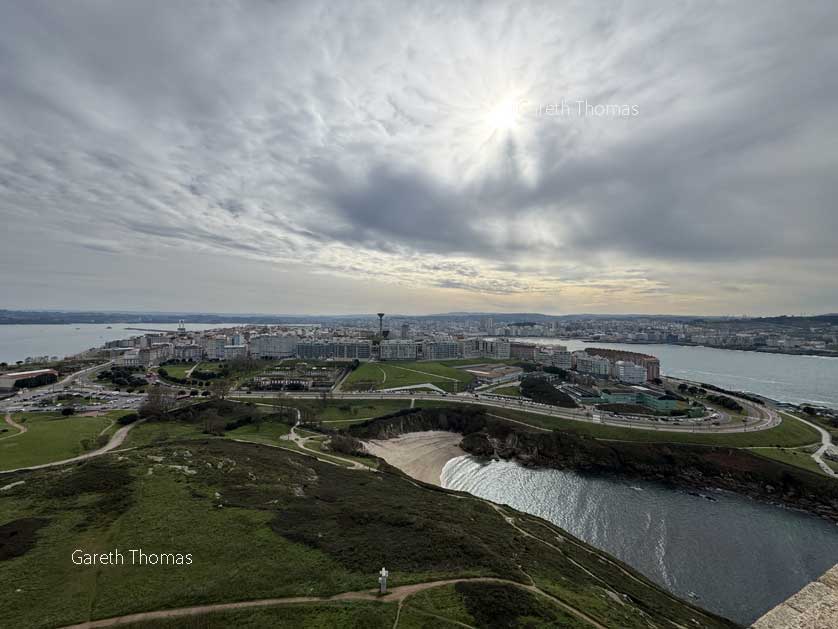
The coastal city of A Coruña (La Coruña) in Galicia, northwest Spain is a major port and gateway to the region.
Located on a peninsula jutting out into the Atlantic Ocean, A Coruña has a population of around 250,000 (making it the second largest city in Galicia after Vigo to the south), is home to the world's oldest functioning lighthouse and also the birthplace of the fashion giant Zara.

What is the History of A Coruña
Originally a Celtic (Artabri) settlement, the Romans under Julius Caesar occupied it around 62 BC, establishing a trade hub, Brigantium. The Tower of Hercules was built in the late 1st century AD or early 2nd century AD to guide Roman navigation.
Following the decline of the Roman empire, the city persisted as a small port, later growing significantly through pilgrimage traffic to Santiago de Compostela in the 10th-12th centuries. King Alfonso IX granted it substantial trading rights in the 13th century.
In 1588, A Coruña was one of the ports from where the Spanish Armada launched its campaign against England and was attacked by the English the following year when they were famously repulsed by María Pita, after whom the city's main square is named.
In 1809, the Battle of Corunna saw the death of the British commander Sir John Moore as the French attacked the British as they were preparing to sail away.
The late 19th century saw the beginnings of industrialization in the port (cigarettes, matches, glass, textiles etc). The clothing brand Zara opened its first store in the city in 1975.
Attractions
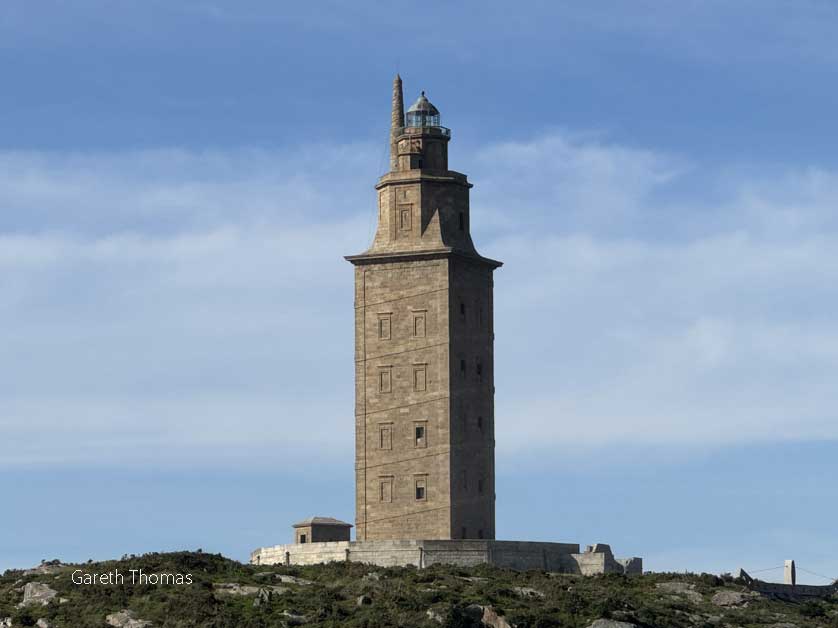
The Romans built the Torre de Hércules in the late 1st or early 2nd century AD. It was designed to guide ships safely along Galicia's treacherous coastline. The structure was likely commissioned during the reign of Trajan, one of Rome's greatest emperors, and engineered by the Roman architect Gaius Sevius Lupus, whose name still appears on an inscription at the base of the tower.
Standing 55 meters (180 feet) tall today, the lighthouse has undergone several restorations over the centuries, most notably by architect Eustaquio Giannini in the 18th century when the exterior was remodeled into the elegant neoclassical form visitors see today.
Despite these changes, the original Roman core remains intact.
In recognition of its historical significance, the Tower of Hercules was designated a UNESCO World Heritage Site in 2009.

Legends
Like many ancient landmarks, the tower is steeped in myth. According to Galician legend, the hero Hercules defeated the giant tyrant Geryon on this very spot after a three-day battle. After burying the giant's head, Hercules built the tower as a victory monument.
Local tradition says the nearby city of A Coruña grew from the first settlement established around the monument. The tower even appears on the city's coat of arms, with the skull of Geryon depicted beneath it.
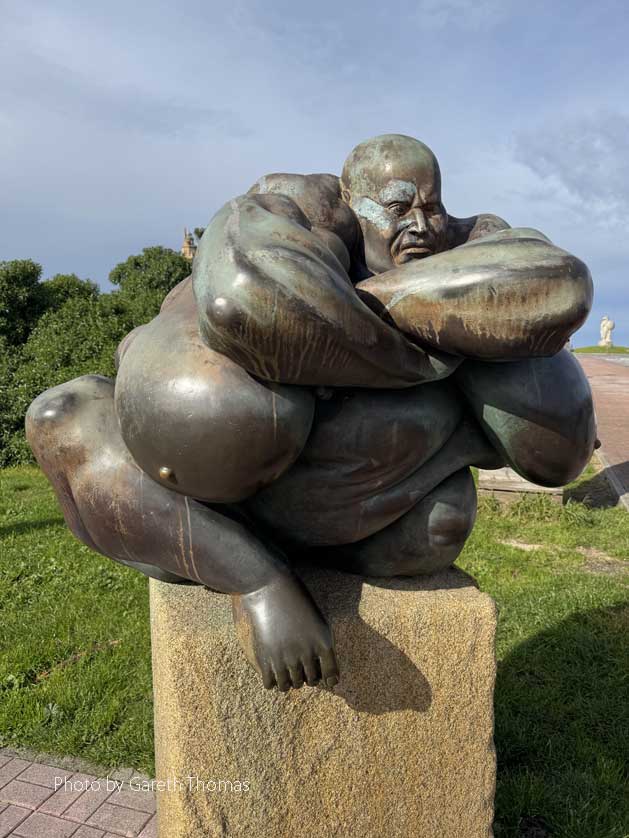
The Lebor Gabála Érenn tells the legend of Breogán, who conquered Spain, founded Brigantia (modern A Coruña), and built a great tower - linked to the Tower of Hercules. His son Íth later sailed to Ireland after spotting the green isle from the tower but was killed. His descendant Míl Espáine then led a successful invasion, defeating the Tuatha Dé Danann and taking control of the whole of Ireland. A statue of Breogán stands in the surrounding Sculpture Park.

The city's main square, Praza de María Pita is named after local heroine María Pita, who drove off the invading English back in 1589. Enraged by the death of her husband, she grabbed a spear and killed the English commander, leading a successful counter-attack to see off the invaders.
The beautiful Town Hall and other fine buildings line this large public space. The Town Hall was built between 1908 and 1912 and houses a free Clock Museum (Museo de los Relojes) with over 80 historic clocks from Spain, England, France and The Netherlands.

Beaches
The town's two main city beaches are Orzán Beach and Riazor Beach which both get very busy in summer. The local football team Deportivo de La Coruña play at the nearby Estadio Abanca-Riazor.

Galerías
The galerías of A Coruña are glass-enclosed balconies that line many of the city's waterfront buildings, especially along Avenida da Mariña. Built mainly in the 19th century, these white-painted structures were designed to maximize available sunlight while shielding homes from the often strong Atlantic winds and rain. Their continuous rows of windows create a bright, reflective façade facing the harbor, earning A Coruña the nickname "City of Glass" or the "Crystal City" (Ciudad de Cristal).
What are Some Worthwhile Museums in A Coruña?
The city has some interesting museums and an outstanding aquarium. The granite and slate Domus (Casa del Hombre), designed by César Portela and Japanese architect Arata Isozaki opened in 1995 and is dedicated to the human being. It features over 150 interactive exhibits.

The excellent Aquarium Finisterrae aka "Casa de los Peces," opened in 1999 near the Tower of Hercules. It focuses on marine life, education, and conservation. The popular Sala Nautilus features a large tank reminiscent of Captain Nemo's study.
The National Museum of Science and Technology (MUNCYT) features a massive collection, including historical scientific instruments, computers, and even a decommissioned airplane.
The Casa de las Ciencias (House of Science) houses a planetarium in the scenic Santa Margarita Park.
The Castle of San Antón Archaeological and Historical Museum is in a former island fortress and covers the history of A Coruña, from prehistory to the Middle Ages.
The Museo de Belas Artes has a substantial collection of paintings, drawings, and engravings, including works by Goya and local Galician artists.
The home where Pablo Picasso lived with his family from 1891 to 1895 is now the Casa Museo Picasso at 14 Calle Payo Gómez. It showcases his early works and recreaties the atmosphere of the period. Altogether there are reproductions of 33 pieces, 29 by the young Picasso and 4 by his father.
The Casa Museo Emilia Pardo Bazán at Rúa Tabernas, 11 is the former home of the renowned 19th-century Spanish author. It is currently closed for renovation.

Parks & Gardens
A Coruña boasts several scenic parks and gardens, ranging from historic city gardens to coastal nature spots. Top green spaces include the Méndez Núñez Gardens in the city center, named after Casto Méndez Núñez (1824-1869) a distinguished 19th-century Spanish naval officer, and laid out on land reclaimed from the sea in the 19th century.
The scenic San Carlos Garden in the Old Town contains the tomb of Sir John Moore. The extensive Santa Margarita Park is the city's largest park, featuring a lake, botanical paths, a playground, and the Casa de las Ciencias (see above).
For coastal views and art, the Tower of Hercules Sculpture Park and Mount de San Pedro are both popular.
Churches
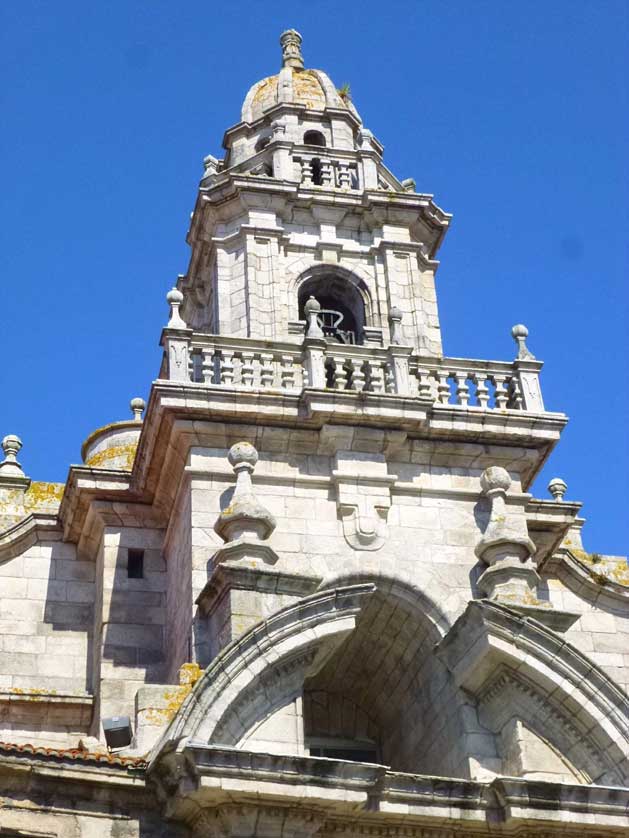
The most interesting churches in A Coruña are concentrated in the historic Old Town (Ciudad Vieja), where medieval Romanesque and later Baroque styles sit side by side. This compact area makes it easy to explore several important religious landmarks on foot, all within close reach of the city center and port.
Among the highlights is the Church of Santa María del Campo, a 12th-century Romanesque church known for its rose window, 13th-century portico, and small museum. Nearby, the Church of Santiago - the oldest in the city - features a classic Romanesque structure with three apses and a striking Gothic rose window. The Convent of Santo Domingo stands out for its dramatic Baroque façade and richly decorated altarpiece.
Also worth visiting are the Church of San Nicolás, admired for its ornate Baroque interior and central location, and the Church of San Xurxo, an elegant Baroque church with historical significance in its surrounding square.
Accommodation
The town and surrounding area has some great places to stay.
The DoubleTree by Hilton offers 4-star accommodation near the Convention Center.
The NH Collection A Coruña Finisterre is a 5-star property. Facilities include 3 outdoor pools, sea views, bar and restaurant.
Eurostars Atlántico has large rooms in a pleasant 4-star hotel.
Other places include Hotel Alda Orzán a 2-star property, which offers more budget lodgings near the beach.
Hotel Brisa is another budget option close to Riazor beach and stadium.
See a listing of hotels in A Coruña
Access - Getting to A Coruña
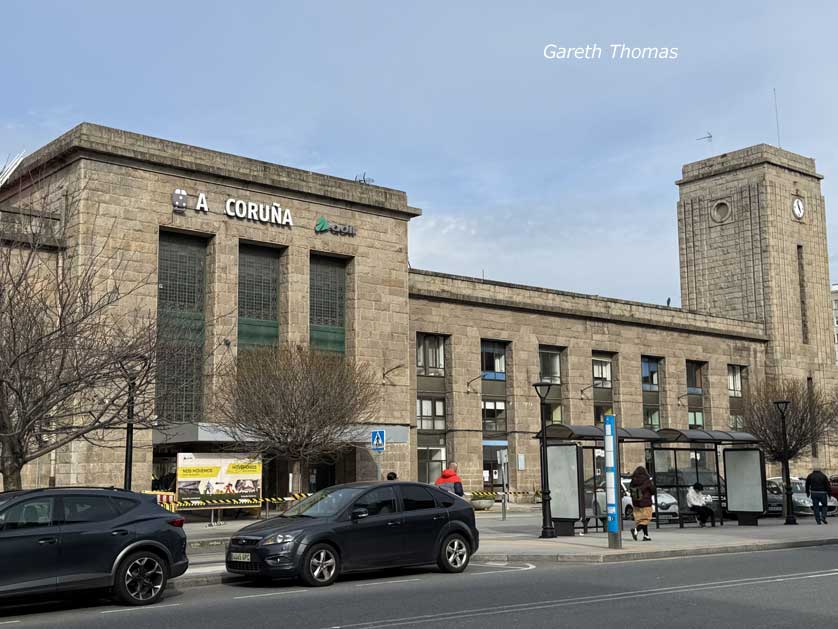
The railway station (A Coruña-San Cristovo) is at Avenida del Ferrocarril 10. High-speed rail services link the city with Santiago de Compostela, Ourense-Empalme, Pontevedra and Vigo-Guixar. Regional trains provide connections to Lugo, Monforte de Lemos and Ferrol, while intercity services run to Madrid, Barcelona and Bilbao.
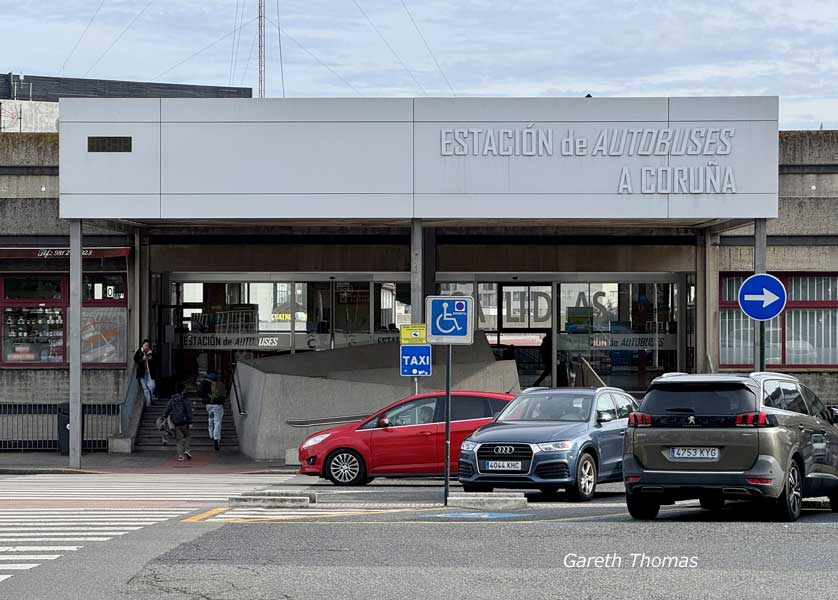
The bus station at Rúa Caballeros 21, 15009 has buses from A Coruña to Madrid, Barcelona, Bilbao, León-Valladolid, Ourense, Salamanca, Santiago de Compostela (1 hour), Verín, Vigo (about two hours, 30 minutes) and Zamora. There are also buses south to Aveiro, Braga, Porto (3 hours, 30 minutes), Fatima and Lisbon (9 hours to Oriente; 9 hours, 30 minutes to Sete Rios) in Portugal as well as a long-distance service to Paris in France.
Map


Eat & Drink
The city is not-surprisingly known for excellent seafood, including the peculiar navajas (razor clams) and hearty Galician cuisine. Some recommended places to eat and sample the local wines are Pulpeira de Lola la Antigua de Melide (Tel: 981 23 61 64) for excellent octopus, mussels and cheese plates on Ronda de Outeiro and the Michelin-starred Taberna 5 Mares which has fine food and sea views at Parque Monte San Pedro (Tel: 981 10 08 23).