Churches & Religious Monuments in Fátima
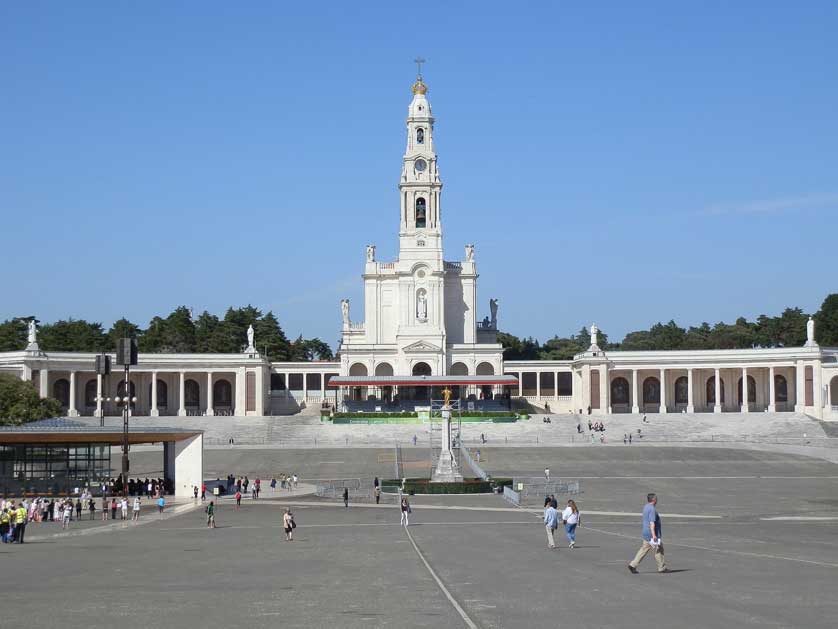
The city of Fátima, in the Estremadura region of central Portugal, is the country's most famous pilgrimage site.
Fátima also rivals Braga as Portugal's most important religious city and is certainly of more international importance and fame.
Second only to Lourdes as Europe's major pilgrimage center, the small town of just 8,000 inhabitants, welcomes millions of devotees a year who come to pray at the site of a miraculous apparition of the Virgin Mary that occurred here in 1917.
Three shepherd children had a vision of Mary, who supposedly reappeared on the 13th of each of six subsequent months calling for peace in the world.
The Sanctuary of Our Lady of Fátima (Santuário de Nossa Senhora de Fátima) in the Cova de Iria district consists of various, important Marian religious sites.
See a listing of the many churches and religious monuments in Fátima.

Basilica de Nossa Senhora do Rosário de Fátima
The Basilica de Nossa Senhora do Rosário de Fátima (Basilica of Our Lady of the Rosary) holds the tombs of Lucia, Jacinta and Francisco - the three children who saw the apparition of Mary in 1917.
Jacinta (1919) and Francisco (1920) perished young in the Spanish flu pandemic but Lucia was to become a Carmelite nun and lived in a convent in Coimbra until her death in February 2005, also on the 13th of the month.
Work began on the huge white basilica in 1928 and was completed in 1953. The original design was by the Portugal-based Dutch architect, Gerardus Samuel van Krieken (1864-1933). His other works in Portugal include the stained glass at the Livraria Lello in Porto. After his death the building work was continued by João Antunes, a Portuguese architect with a famous 17th-18th century namesake.
The spire of the church rises to 65 meters and the front of the church is flanked by colonnades facing the huge square. This is the work of António Lino (1914-1996) and consists of 200 columns surmounted by 17 statues of saints with the tallest rising to over 3 meters in height. Lino collaborated with the ceramicist Manuel Cargaleiro in creating the ceramics within the colonnade.
The spire is topped with a 7000 kg bronze crown, built at the Bolhão foundry, Porto, surmounted by a cross, which is illuminated at night.
The interior includes stained glass windows depicting the events of the Marian apparitions. There are 15 altars within the church mirrowing the 15 mysteries of the rosary.
Basilica de Santissima Trindade
The Basilica de Santissima Trindade (Basilica of the Most Holy Trinity) is at the other end of the huge square from the Basilica of Our Lady of the Rosary.
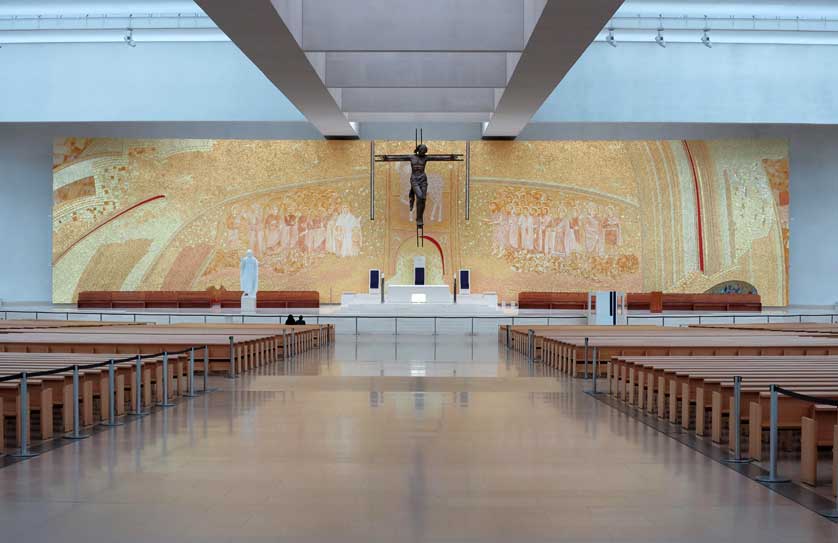
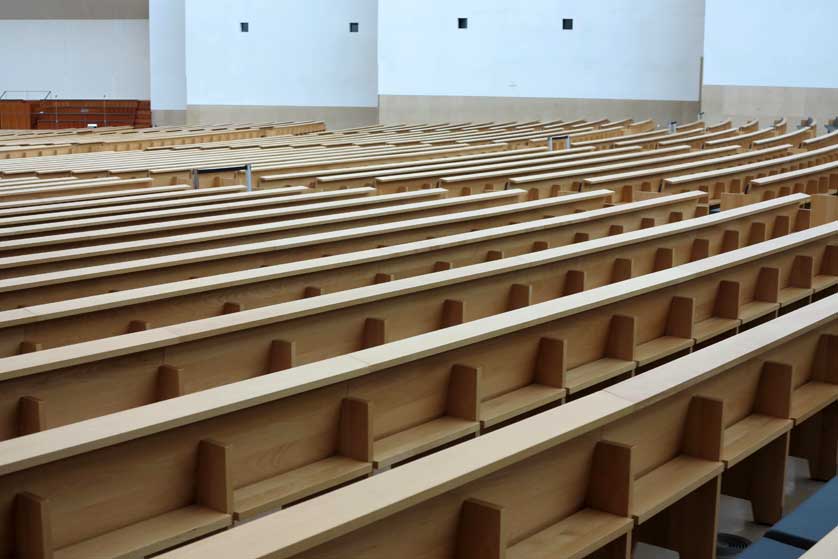
The Basilica of the Most Holy Trinity is a contemporary building consecrated in 2007. In part, it was built to ease congestion at the Basilica of Our Lady of the Rosary on pilgrimage days. In all the church took over three years to complete.
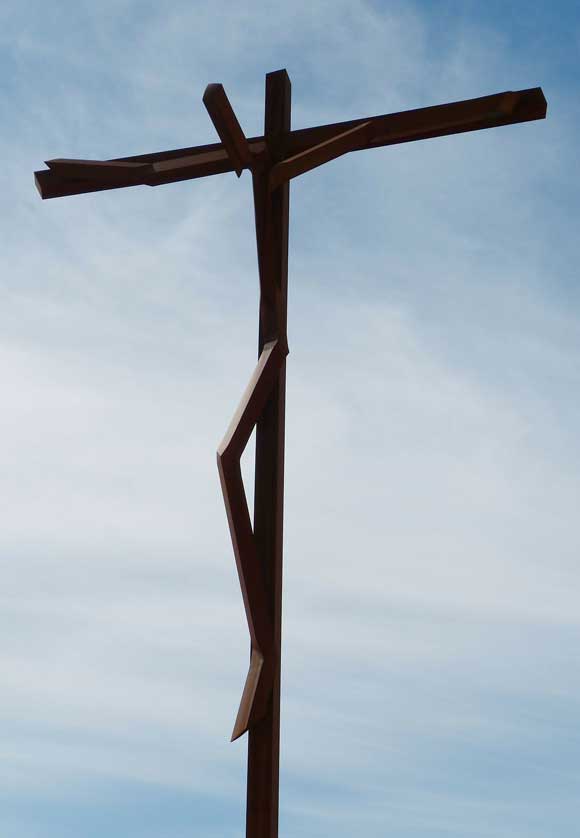
The huge structure, designed by Greek architect Alexandros Tombazis, is one of the largest Catholic churches and can hold an amazing 8,500 worshippers. The sculpture of Christ Crucified outside the church is by German artist Robert Schad.
The church is decorated with various pieces of religious art by several well-known Portuguese and international artists.

Capela das Apariçoes
The Capela das Apariçoes (Chapel of the Apparitions) marks the exact spot where three young shepherd children (Jacinta, Francisco and Lucia) reported having seen apparitions of the Virgin Mary in 1917.
The chapel is the earliest building in Fatima to mark the apparitions of the Virgin Mary. It was built by a local mason and bricklayer in 1919 and held its first mass in 1921. The chapel replaced a simple wooden arch built over a holm oak tree where the Virgin Mary supposedly appeared to the three children.
In 1982 the chapel was covered with a roof designed by the architect José Carlos Loureiro to mark the visit to Fatima of Pope John Paul II. In 1988 the chapel was lined with Siberian pine, chosen for its lightness and durability.
The 137-centimeter tall, 19 kilogram image of the Virgin, within the chapel is made of Brazilian cedar and was commissioned from a company in Braga.
The golden crown embedded with pearls and precious stones was added later in 1942 in thanks for Portugal having avoided participation in World War II.
The bullet that struck Pope John Paul II in an assassination attempt in 1981 was given to the chapel in thanks for the Virgin having saved the pope's life.
The image occasionally leaves the Capelinha das Aparições on tour for special occasions. It has been taken to various religious festivals in the Vatican, Rome, the Monument to Cristo Rei in Lisbon, Leiria, Elvas, Vila Real de Santo António as well as Badajoz and Madrid in Spain.
Sculpture of Christ Crucified
The minimalist, steel Sculpture of Christ Crucified by German artist Robert Schad stands outside the Basilica of the Most Holy Trinity (Basilica de Santissima Trindade).
The artist had studied in Porto and spent some time each year in the country. He was asked by Alexandros Tombazis to contribute to the Basilica de Santissima Trindade project.
The 34-meter-tall sculpture beckons visitors to enter the basilica and is designed in its simplicity of form to appeal to believers from all nations of the world.
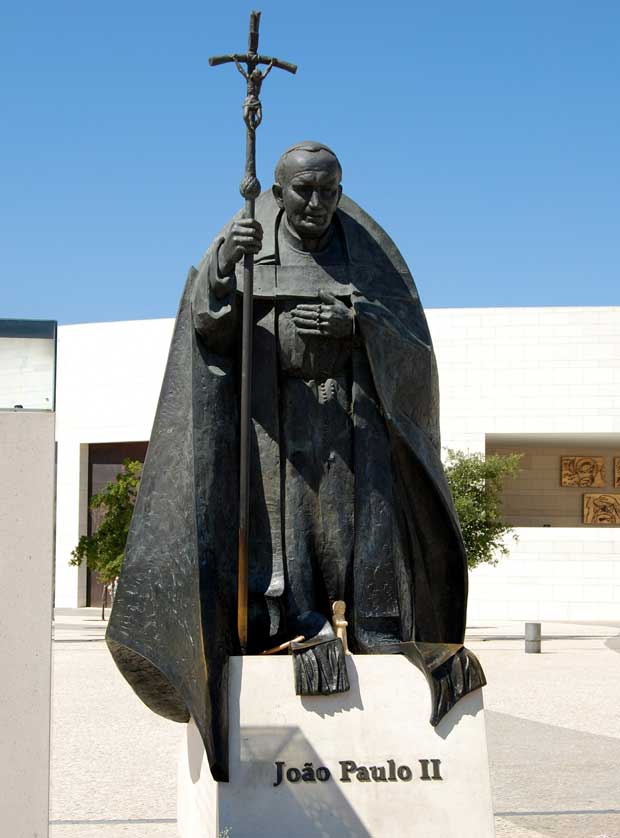
Statue of Pope John Paul II
The Statue of Pope John Paul II by Polish sculptor Czeslaw Dzwigaj is also part of the several international contributions to the Basilica de Santissima Trindade.
The artist is known for his many monuments of fellow Pole, Pope John Paul II.
Dzwigaj has produced over 50 statues of the pope which stand in his native Poland and many other countries including Argentina, Lithuania, Portugal, Spain, the USA, Italy and Germany.
Hotels in Fatima
Fatima has literally hundreds of hotels and guest houses that cater to the estimated 4 million pilgrims who visit Fatima every year.
Places to stay in Fatima include Avenida de Fatima, Hotel Lux, Hotel Lux Mundi, Hotel Anjo de Portugal, Luna Fatima Hotel and Cova da Iria Hotel.
See here for a full list of hotel accommodation in Fatima.
It is also possible to stay in nearby Ourém, 12 km to the east.