Military Museums (Museu Militar) in Portugal
Portugal's Military Museums

Portugal is immensely proud as a nation of its history of exploration and expansion during the Age of Discovery period during the 15th and 16th centuries. Utilizing the latest navigational and ship-building technology of the day, Portuguese sailing vessels under the command of such men as Gil Eanes, Bartolomeu Dias (1457-1500), Vasco da Gama (1460-1524), Pedro Álvares Cabral (1467-1620) and Afonso de Albuquerque (1453-1515) explored and colonized first Madeira and the Azores, then the coasts of Africa, Brazil and India. They also ventured further east as far as Malaysia, Macau and even Japan.
Some Historical Background
Portuguese fleets were accompanied by both soldiers and Catholic priests. This forced export of gun and Cross were to heap considerable misery on some of the peoples encountered by the adventurers. Not least among the estimated 5-6 million African slaves taken to the Americas (mostly Brazil) between 1526 and 1836 when the Atlantic slave trade was finally banned in Portugal, under pressure from Britain (the second most prolific slave trading nation after Portugal). However, slavery within Portuguese colonies in Africa would not be completely abolished until 1869.
This dark side of Portuguese history is rarely addressed in Portuguese schools and its museums. Although the Slave Market (Mercado de Escravos) located in the old town of Lagos on the Algarve is a fascinating recent museum dedicated to the slaves that were brought to Portugal beginning in 1444.
Indeed it was only in 2023 that Portugal's President Marcelo Rebelo de Sousa said his nation should apologise and take responsibility for its role in the transatlantic slave trade.
Portugal's military museums (Museu Militar) - often located in its castles and fortresses - focus largely on the Age of Discovery, as well as Portugal's participation in the Peninsular War (1807-1814) on its own territory, World War I when Portugal fought on the side of the Western Allies and the conflicts in its African colonies Angola, Mozambique and Portuguese Guinea (Guiné-Bissau) between 1961 and 1974. The latter wars would lead to the downfall of the Estado Novo dictatorship of António Salazar and his successor in the Carnation Revolution of 1974.
See a listing of military museums in Portugal.

Museu Militar de Lisboa
The Military Museum (Museu Militar de Lisboa) is situated in the eastern part of Lisbon, adjacent to Santa Apolonia train station. The majority of Portugal's large towns and cities boast a Museu Militar; Lisbon's is the largest in the country and among the largest in the world. It is on a par in size with the Imperial War Museum in London.
Lisbon's Museu Militar is housed in a grand building that was formerly the Royal Arsenal, where foundries were established to build artillery pieces and cannons from the late 15th century of Portuguese history.
The museum displays an extensive collection of armour, weapons, paintings, uniforms and historical military documents.
One room in the museum is dedicated to the explorer Vasco da Gama with a collection of old cannons and modern murals depicting the discovery of the sea route to India. Vasco da Gama's sword is also on display here. Another room is dedicated to the Peninsular War, fought by Portuguese and British troops against Napoleon.
The first floor has exhibition rooms focused on the First World War, when Portuguese forces clashed with German troops in its African colonies of Angola and Mozambique. Portugal also sent over 50,000 soldiers to the trenches of the Western Front where they fought with heroism and sustained terrible losses.

Museu Militar do Porto
The Military Museum of Porto (Museu Militar do Porto) is housed in a 19th century building in the Bonfim district of Porto, in what was formerly the headquarters of the feared secret police - PIDE (Polícia Internacional e de Defesa do Estado) during the time of Salazar and the Estado Novo (New State).
The building is still run by the Portuguese military and visitors are greeted by a soldier in full uniform at the reception. Inside is a fascinating collection of around 16,000 miniature soldiers produced by various European companies such as Britains (UK), Elastolin, Heyde and Lineol (all Germany). These are arranged in chronological sets by nation in glass cases.
The main building, which visitors are directed to see first, contains the collection of toy soldiers, paintings and the more ancient and valuable of the historic weapons and uniforms on the second floor. These include an original sword of Afonso Henriques (1109-1185), the king who established Portuguese independence from Galicia and defeated the Moors in the south of the country.
The first floor of the main building has a room dedicated to the 1891 Revolution, the first attempt to establish a republic in Portugal and exhibits from the Napoleonic Wars. The larger guns and vehicles from World War I and World War II are in the grounds of the main building and in the two story, hangar-like Pavilhão das Armas. Other exhibits include insignia, photographs, uniforms, vehicles, artillery pieces and other weapons.

Museu Militar de Bragança
The keep of Bragança Castle within the historic walled citadel (Cidadela) of Bragança contains one of the best of Portugal's numerous military museums - the Museu Militar de Bragança. The Torre de Menagem (keep) is 33 meters tall and was occupied by the Portuguese military well into the 20th century. In 1929 the space was converted into a museum by an officer in the regiment stationed here with many of the exhibits donated by local inhabitants of Bragança.

Museu Militar da Madeira
The Madeira Military Museum (Museu Militar da Madeira) in Funchal is within the historic Palácio de São Lourenço on Avenida Zarco. A useful phone app guides visitors around exhibits of weaponry from the Age of Discoveries to the present day. Also on display are uniforms, paintings and photographs. A visit also includes European and Portuguese art as well as royal portraits from the 17th, 18th and 19th centuries in the São Lourenço Palace Museum.
The collection of the Museu Militar da Madeira includes weapons, uniforms, paintings and other objects relating to the history of Madeira and its military forces. Wall panels explain the main historical events that have taken place in Madeira. The islands of Madeira and Porto Santo became important bases as fleets from Lisbon set off for Brazil, Africa, India and the Far East. The ships stopped at the islands to take on provisions (water, wine, food etc) and also many sailors from Madeira served on these expeditions.
The militarization of Madeira began in earnest after a raid by French corsairs in 1566. Two Italian military engineers and Mateus Fernandes, the royal master builder were despatched to the island to improve its defences.

Museu Militar de Chaves
The Torre de Menagem in Chaves, is all that remains of the original 14th century castle completed during the reign of King Dinis I (1261-1325). Inside the keep is a small Military Museum (Museu Militar de Chaves).
The square Gothic keep, made from local granite, has four floors which now house a Military Museum with exhibits of cannon, muskets and other military equipment and uniforms from various conflicts, including Portugal's wars in its overseas colonies in the 1960's and 1970's.
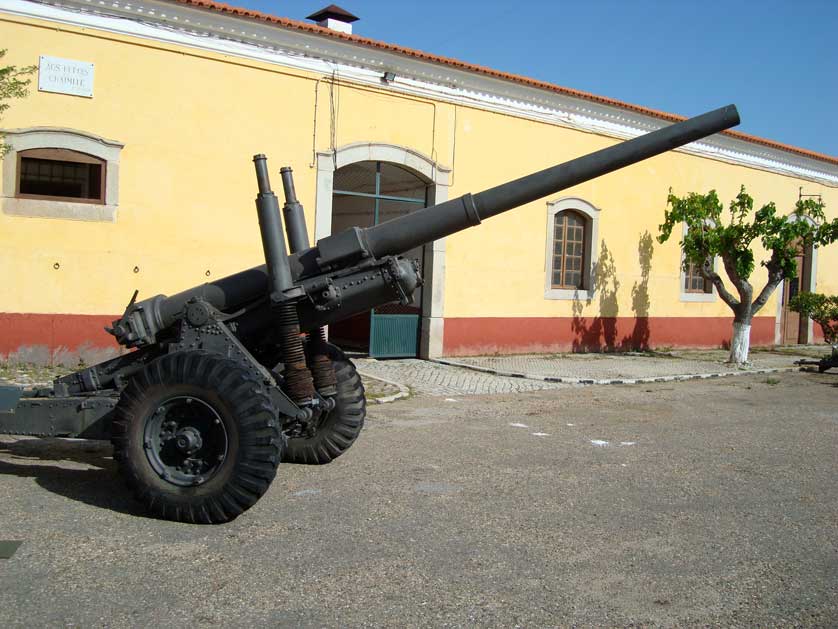
Museu Militar de Elvas
Elvas still has a Portuguese military presence right up to the present day. The museum is at Avenida de São Domingos 13.
Exhibits include artillery pieces, vehicles, medical equipment and uniforms. The museum opened in 2009. Closed Mondays; from November to March, Tuesday to Sunday from 9.30 am to 12.30 pm; 2 pm to 6 pm; April to October, Tuesday to Sunday, 10 am to 12.30 pm; 2.30 pm to 7 pm.

Museu Do Combatente
Located near the historic Belem Tower and the Mosteiro dos Jeronimos in Belem in the west of Lisbon, the Museu Do Combatente is Lisbon's other notable military museum after the more worthwhile Museu Militar on the other side of the city.
Housed in an 18th century fort guarding the approach to Lisbon on the River Tagus the Museu Do Combatente is dedicated to the men and women killed in action among the Portuguese armed forces from their bloody involvement in World War I through equally grisly conflicts in colonial Angola and Mozambique.
The riverside Museu Do Combatente displays a collection of uniforms, arms, a tank, the cockpit of a Fiat G91 aircraft widely used by the Portuguese Airforce during the Guerra do Ultramar (Colonial Wars) in Africa, many World War II vintage model aircraft and a number of pieces of artillery.

Museu Guarda Nacional Republicana
The Museu Guarda Nacional Republicana (Museu da GNR) is housed in a historic barracks in the Chiado district of Lisbon virtually next door to the Convento do Carmo. The museum has been open to the public since 2015. The building itself has been the site of several incidents of great historical importance.
Dedicated to the history of the GNR the museum contains both a library and archive. The GNR was created in 1911 following the creation of the First Portuguese Republic in 1910. The GNR is a direct descendant of the previous Guarda Real da Polícia de Lisboa and the subsequent Guarda Municipal.
Members of the GNR are military personnel and have served overseas in peacekeeping roles.

Castelo do Queijo
The small Castelo do Queijo in the upmarket suburb of Foz do Douro in Porto is dedicated to Portugal's commandos, who saw action in her former colonies in Angola and Mozambique. On display are maps, regimental insignia, weapons and photographs.

Castelo de Castelo de Vide
Inside the Castle of Castelo de Vide is a small museum part Military Museum, part Archaeological Museum. On display are a collection of historic weapons (cannon, cannonballs, muskets, etc), Roman pottery, Stone Age arrowheads and other archaeological finds from the menhirs (standing stones) of northern Alentejo.

Related
Lisbon Stay
Hotels in Portugal - Booking.com
Hotels in Lisbon - Booking.com
Lisbon Hop-On Hop-Off Bus, Tramcars, and Yellow Boat River Tour