Sintra National Palace
Sintra National Palace (Palácio Nacional de Sintra)

The Sintra National Palace (Palácio Nacional de Sintra) in Sintra forms part of the UNESCO World Heritage cultural landscape in this pretty town west of Lisbon.
The palace configuration visitors can see today dates mainly from the reigns of Dom Dinis, João I and his queen, Philippa of Lancaster, Manuel I and João III.
The Palácio Nacional de Sintra became a favorite retreat for the Portuguese court in summer who came here to relax and enjoy hunting in the area as well as escape outbreaks of plague in the capital.


History
Sintra was previously a Moorish town before it was retaken by Christian forces under Portugal's first monarch, Afonso Henriques (1109-1185) in 1147.
The site of the Palácio Nacional de Sintra is thought to have been a Moorish fortress occupied by a governor. Nothing, however, remains of the early Moorish and Christian buildings on the site.
The structures we see today were built from the 14th and 15th centuries on starting with work by King Dinis I and King John (João) I. Some of the famous rooms in the Palácio Nacional de Sintra include: the Swan Room (Sala dos Cisnes), the Magpie Room (Sala das Pegas), the Blazons Hall (Sala dos Brasões) and the Arab Room (Sala dos Árabes).
Further expansion of the Palácio Nacional de Sintra was undertaken by King Manuel I from 1497 to 1530, financed by the wealth generated by the so-called Age of Discoveries, as Portuguese explorers such as Bartolomeu Dias and Vasco da Gama expanded Portugal's trade routes with South America and Asia.
Features of this new "Manueline" style include azulejos tiles, harking back to the Moorish period, and decorative motifs referencing the new maritime explorations. It was Manuel who built the impressive Sala dos Brasões.
In the 18th century, the palace was damaged in the 1755 Great Lisbon Earthquake but was repaired in the following years.
One note of sadness connected with the building is the Room of Afonso VI (1643-1683) who after a period of exile in Angra do Heroísmo on the island of Terceira in the Azores was incarcerated in this room for nine years until his death.

The Palace
The Swan Room (Sala dos Cisnes) and the Magpie Room (Sala das Pegas) are named after the paintings of the two birds on the respective ceilings of the palace.
The Magpie Room (Sala das Pegas) was a meeting room where the monarch received notable visitors and later took on the function of a banqueting room. The Swan Room (Sala dos Cisnes) became the Great Hall of the Palace during the time of King João I and his English wife Philippa of Lancaster. The queen's brother Henry IV of England used a crowned swan as a personal emblem.
The Golden Chamber (Câmara do Ouro) completes this suite of three rooms and was used for meeting those of very high social status and also as a royal bedroom, used by the unfortunate King Sebastian.
One part of the Palace of particular note is the Blazons Hall (Sala dos Brasões) in its western part. Its decorations are overwhelmingly heraldic. The ceiling, with its octagonal dome, is its most spectacular feature, with the royal Portuguese coat of arms (that of Manuel I), framed by a winged dragon, at its very top.
Below it, around the beautifully tiled walls are scores of other coats of arms of the children of the great Dom Manuel I, and below it, of 72 other noble clans.
The Chinese Room (Sala Chinesa) takes its name from an 18th century ivory pagoda on display here.
The Chamber of Afonso VI is where the unfortunate king, deposed by his brother, spent the last years of his life under guard. The ceramic flooring here dates from the mid-15th century.
Also dating from the 15th century is the Arab Room (Sala dos Arabes) with a Moorish fountain and beautiful azulejos tiles - the water feature and tiles invoke the rich Moorish legacy of Portugal's history.
The Galley Room dates from the time of King João III and takes its name from the vessels painted on the ceiling.
Altogether eight rooms make up the Chambers of Queen Maria Pia of Savoy, the last queen of Portugal to actually reside in the palace. They include the queen's bedroom, toilette and sitting room.
The Royal Kitchen shows the scale of the catering facilities needed to feed a royal court running into hundreds of people. It was here that animals killed in the royal hunts were prepared for the table.
The Chapel
The Royal Chapel, possibly dates from the reign of King Dinis I in the early 14th century and is the oldest part of the palace. The tiled floor in the apse is cleverly constructed to resemble a carpet. The walls are painted in patterned squares that look like tiles and show the Holy Ghost descending in the form of a dove. Geometrically patterned Moorish latticework decorates the wooden ceiling.



The Gardens
West of the palace are the gardens extending over several terraces. These include the Araucaria Garden, the Kitchen Garden, the Preta Garden, the Princes' Garden and the Tanquinhos Patio. All have lovely views over the surrounding hillsides. The Preta Garden is marked by a twisting Manueline column.
Other highlights in Sintra include the Palácio de Monserrate, Quinta da Regaleira, the Castle of the Moors and Pena Palace.
Another palace in Sintra is the Palácio de Seteais - now a luxury, five-star hotel. Further attractions are the impressive Museu de História Natural de Sintra, the recent NewsMuseum, the fascinating Convento dos Capuchos and the Museu Anjos Teixeira, which displays the sculptures of two great contemporary Portuguese sculptors father and son Artur Anjos Teixeira (1880-1935) and Pedro Anjos Teixeira (1908-1997). The Camara Municipal de Sintra (Sintra Town Hall) is also a wonderful piece of architecture completed in 1909 in an aesthetically pleasing mix of Manueline and Romantic styles.


Information
Palácio Nacional de Sintra
Tel: 21 923 73 00
www: parquesdesintra.pt
Hours: 9.30 am-6.30 pm
There are reductions with the Lisboa Card, the gardens are free to enter.
From Sintra Station take Scotturb buses 434 or 435.
Book tickets for the Castle of the Moors & National Palace with Tiqets

Getting to Sintra
Buses
There are local buses from Sintra to Cascais (#417), Estoril (#418) and Mafra. From Sintra Station a number of buses run by Scotturb around the sights. Bus #433 (Urbana Sintra) runs into historic Sintra on a circular route. Bus #434 (Pena Tourist) leaves the station 3 (in winter) or 4 times an hour for Sintra Castle, Pena Palace, Vila and Sintra NewsMuseum. Bus #435 also connects to various destinations in the historic center. To get to Cabo da Roca take either bus #403 or the open top tourist bus, Circuito da Roca.

Trains
Sintra Station connects on the Sintra Line to Rossio Station, Oriente, Entrecampos, Sete Rios and Campolide.
There are trains to Sintra approximately every 15 minutes from Rossio on weekdays and every 30 minutes on weekends, with the journey between Lisbon and Sintra taking 39 minutes. On weekdays after 8.38 pm the service is every 30 minutes.
The first train from Rossio is at 6.08 am with the last train at 1.08 am. The last train from Sintra to Rossio leaves Sintra at 12.44 am.

Portugal Hotel & Hostel Accommodation
Recommended accommodation in Sintra must include the Tivoli Palácio de Seteais. It is a luxury 5-star hotel set on a hilltop with superb views of the Moorish Castle and Pena Palace. Facilities include a swimming pool, tennis courts and an equestrian center.
Book Hotel Accommodation in and around Sintra
The four-star Pestana Hotel offers a golf course and outdoor pool.
Tivoli Sintra Hotel, also four-star, has well-appointed guest rooms and superb views complete with a recommended restaurant and bar.
With three stars the VIP Inn Miramonte Hotel has an outdoor pool and games room.
See a complete listing of hotels and guesthouses in Sintra.
Hotels in Portugal - Booking.com
Hotels in Lisbon - Booking.com
Lisbon Hop-On Hop-Off Bus, Tramcars, and Yellow Boat River Tour
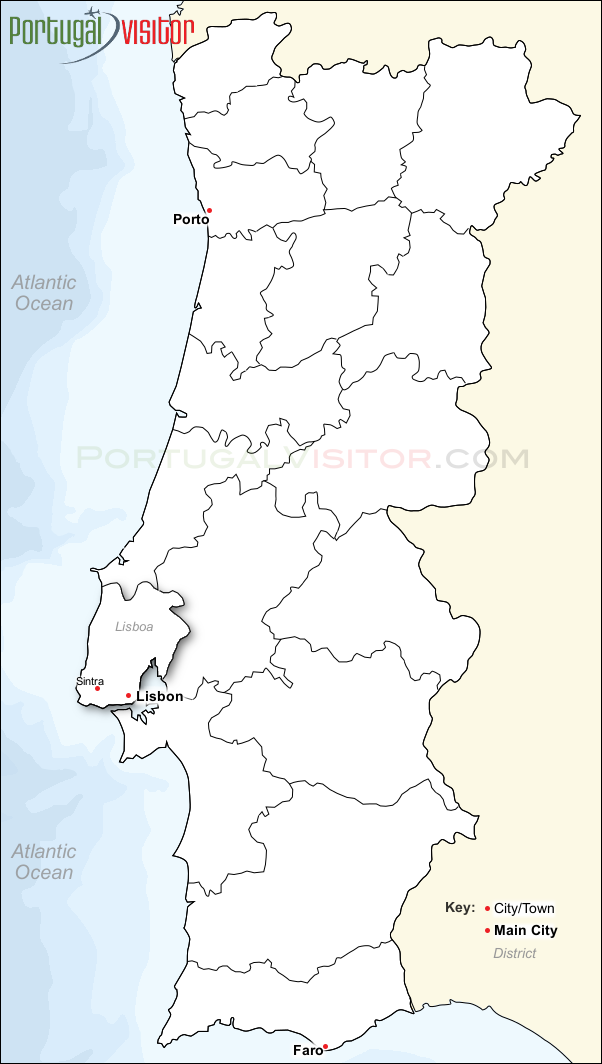
Map