Art on the Lisbon Metro
Contemporary Art on the Lisbon Metro


History
Art has been incorporated into Lisbon's metro stations since the first stations were built in the 1950's.
Architect Francisco Keil do Amaral (1910-1975) and his wife, artist Maria Keil (1914-2012) were responsible for the first eleven stations to open on the Lisbon metro such as the classic Parque Station.
Later as more stations were added to the network, individual artists or teams of artists were chosen to decorate a particular station. Often, the art would reference the location and history of the area the station served.
When other stations opened in the 1980's work by the artists Manuel Cargaleiro, Rolando Sá Nogueira, Júlio Pomar, and Maria Helena Vieira da Silva was included.
In the 1990's work by Françoise Schein and Federica Matta (Parque Station), Bartolomeu Cid dos Santos (Entre Campos Station) and Julio Resende (Jardim Zoológico Station) was commissioned to beautify the network.
Travelers on the Lisbon metro can admire the tile art of Eduardo Nery (Campo Grande Station), the work of Jacinto Luís (Potinha Station), Jorge Martins (Chelas Station), and the sculptures of Pedro Cabrita Reis and Rui Sanches (Olaias).
The world's first underground railway in London used tiles to decorate the platforms of its stations. The Portuguese cultural tradition of azulejos tile panels is well represented in Lisbon's traditions and reflects the ornate decoration of the city's churches and mosaic-like calçada pavements.
If you are interested in modern art or it is a rainy day take a trip around the Lisbon metro using a Lisboa Card, (which is also valid on Lisbon buses, trams and elevadors) or a Viva Viagem card, to see some of the finest contemporary civic art and architecture in Europe.

Selected Stations For Best Art on the Lisbon Metro
Here is a list of some of the best stations on the Lisbon metro for modern art in alphabetical order according to the line. Lisbon's subway has four lines: the Blue Line (Linha Azul), Green Line (Linha Verde), Red Line (Linha Vermelha) and the Yellow Line (Linha Amarela).
Blue Line Stations
There are 18 stations on the line which connects Santa Apolónia in Alfama near the River Tagus to the northern terminus of Reboleira.
Avenida
The art in the station is the work of the artist Rogério Ribeiro (1930-2008) first for the original 1959 station and again in 1982 when it was refurbished. Ribeiro's tiles in mainly yellow, light green, blue and white produce rhythmic surfaces of circles and a diamond point theme that references the Casa dos Bicos in the Alfama district.
Parque
Parque Station is one of the original 11 stations of the network, all of which except Avenida (above) had artwork by painter Maria Keil (1914-2012). Keil's azulejos reference the work of the writer Fernando Pessoa and others. Parque Station was later refurbished by artists Françoise Schein and Federica Matta. They created the blue cathedral at Parque with 450,000 hand-painted tiles in 1994. There are maps of the world inspired by Portugal's Age of the Discoveries period juxtaposed with quotes with an emphasis on human rights by such writers as Lao-Tse, Plato and Gilles Deleuze, author of Capitalism and Schizophrenia.
Restauradores
Restauradores Station has art by Maria Keil with later additions in 1994 by painter Luiz Ventura, whose amazing work Brasil-Portugal: 500 anos - A Chegança is represented in tile. More art was installed in 1998 by the architect and artist Nadir Afonso and the sculptor Lagoa Henriques.
Green Line
The Green Line runs 9 km from the northern terminus of Telheiras to Cais do Sodré.
Baixa-Chiado
Baixa-Chiado Station opened in 1998. The art at the station is by Ângelo de Sousa (1938-2011). Minimalist in style the decoration is in the form of symmetrical bars with semicircles and geometric symbols.
Campo Grande
Campo Grande Station has tile panels by Eduardo Nery (1938-2013). Like much of his work, the panels on the platforms play on the dismantling of the mechanisms of visual perception.
Martim Moniz
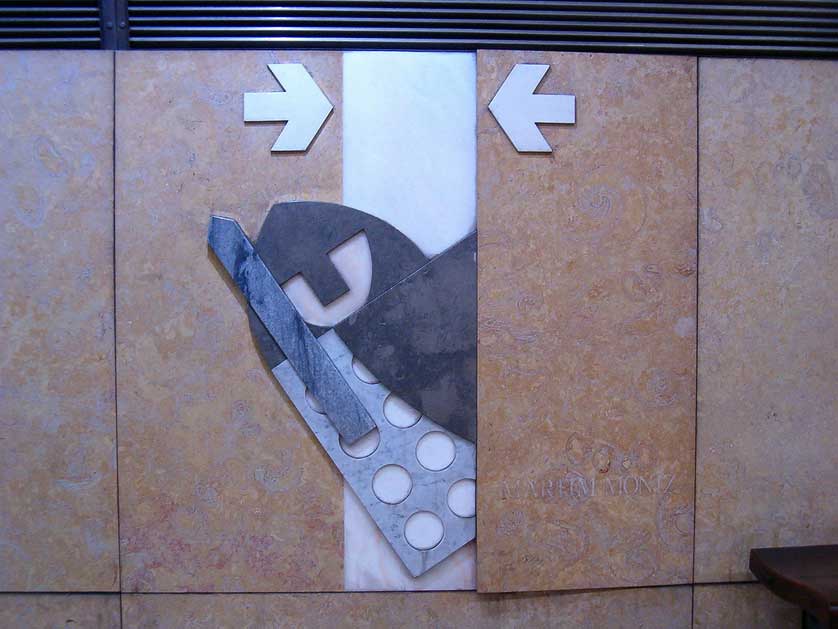
Martim Moniz Station celebrates the "hero" of the siege of Lisbon Castle and is named after him. The legend goes that the brave knight sacrificed himself by throwing his body in the doorway, thus preventing the Muslim defenders from closing the door and allowing the Christian attackers to take the castle. The station was designed by Denis Gomes with art installations by the painter Maria Keil.
Rossio
The main Rossio Station is a cathedral of Neo-Manueline architecture. The metro station has art by Maria Keil. The artist based her design on a modern reinterpretation of Islamic tiles, some of which were discovered in excavations for the station itself. Using the dry-rope technique developed in Moorish Iberia, the tiles are a mix of geometric shapes including circles, stars and armillary spheres.
Red Line
The Red Line runs 10 km from the northern terminus of Aeroporto to São Sebastião. The line is also called the Linha do Oriente. This is the newest of the four lines.
Olaias
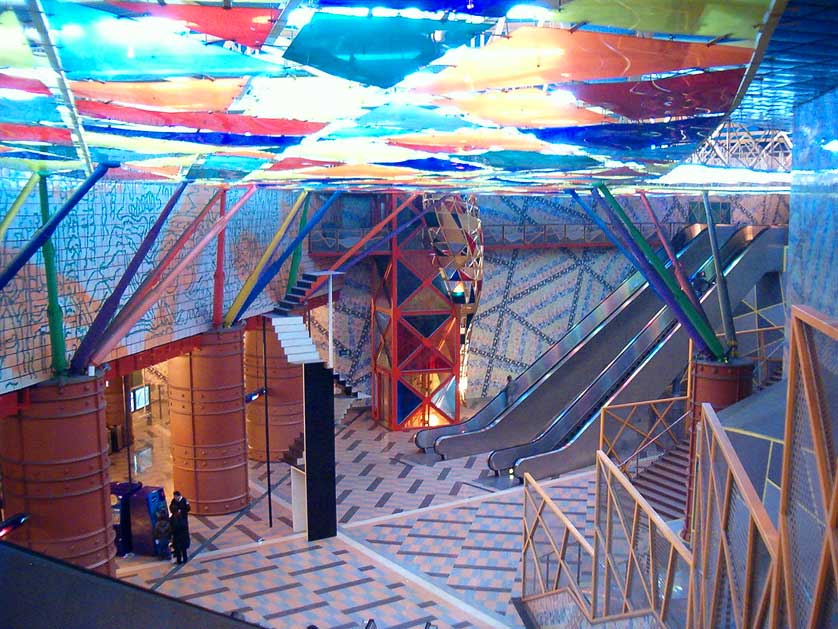
Olaias Station is done on a grand scale by architect Tomás Taveira, who has designed a number of soccer stadiums in Portugal with art installations by Pedro Calapez, Graça Pereira Coutinho, Pedro Cabrita Reis and Rui Sanchez. It is often described as the most beautiful of the metro stations in Lisbon.
Oriente
Oriente Station has art works by a variety of well-known international artists including Yayoi Kusama, Erró, Abdoulaye Konaté, Arthur Boyd, Sean Scully and Magdalena Abakanowicz. Altogether 10 artists were commissioned to produce tile murals on the theme of the 1998 Expo: "The oceans, a heritage for the future."
Saldanha
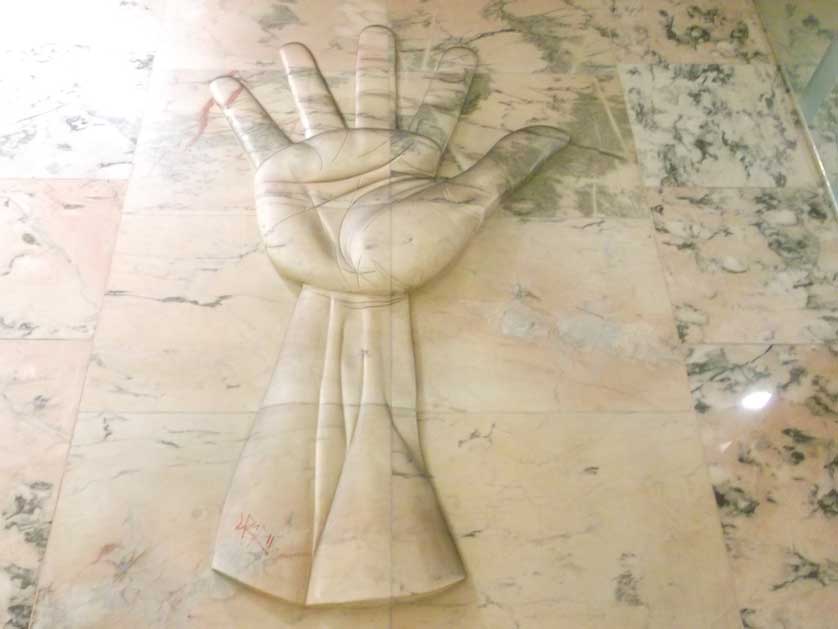
Saldanha Station is on both the blue and the red lines of the capital's underground. The station has art by a number of different artists. Jorge Vieira sculptures use pink marble from the Borba district of Alentejo to depict "the instruments of man's work" such as hands, arms and the head. Luís Filipe de Abreu's tiles have themes such as the "Four Elements" and "The Seasons."
Yellow Line
The Yellow Line (Linha Amarela) has 13 stations between Odivelas and Rato.

Campo Pequeno
Campo Pequeno Station close to the Campo Pequeno bullring has art by Maria Keil from when the station first opened and later additions in the 1990's by Portuguese sculptor Francisco Simões. These are striking life-size, marble figures of women (Women of Lisbon). The colors of the figures show the different shades of Portuguese marble.
Cidade Universitária
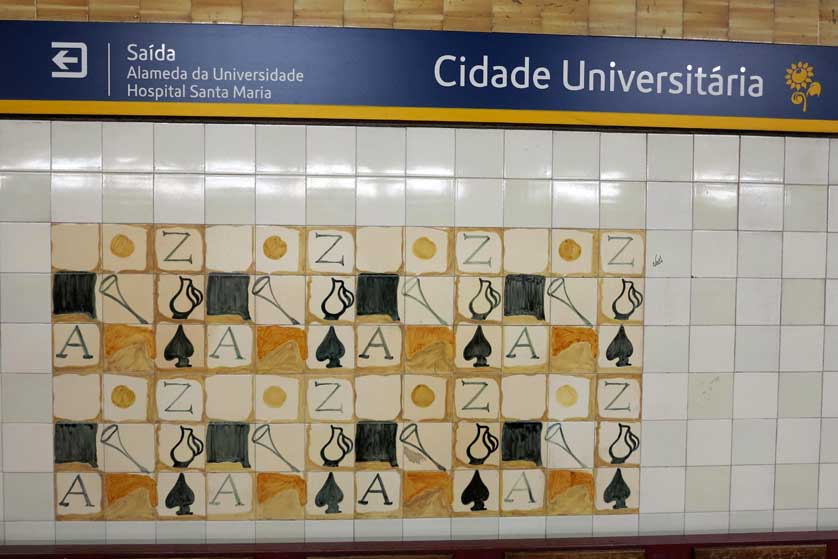
Cidade Universitária Station displays tiles produced by Manuel Cargaleiro in 1988 from the abstract paintings of Maria Helena Vieira da Silva.
Picoas
Picoas Station is of interest both inside and out. The entrance to the station has an original cast iron entrance way that was donated by the Paris metro. The platforms contain art work by Portuguese artist Martins Correia (1910-1999) in azulejos tiles and sculpture. The theme of Correia's work is Lisbon and its people.
Aeroporto
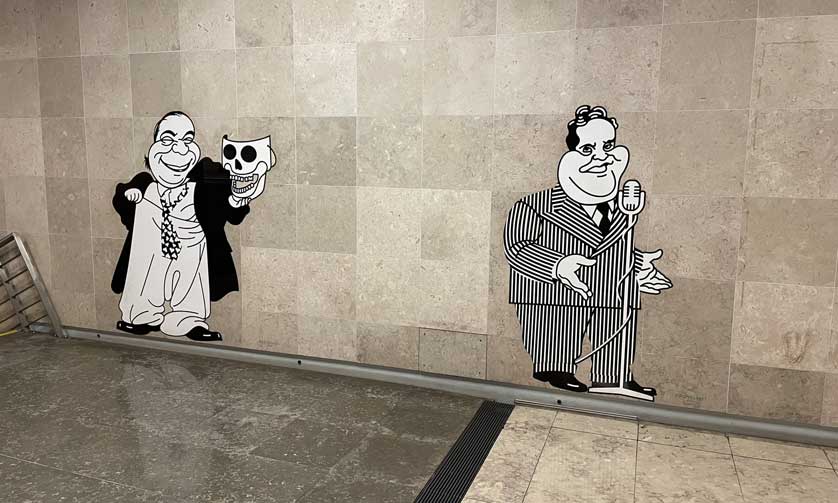
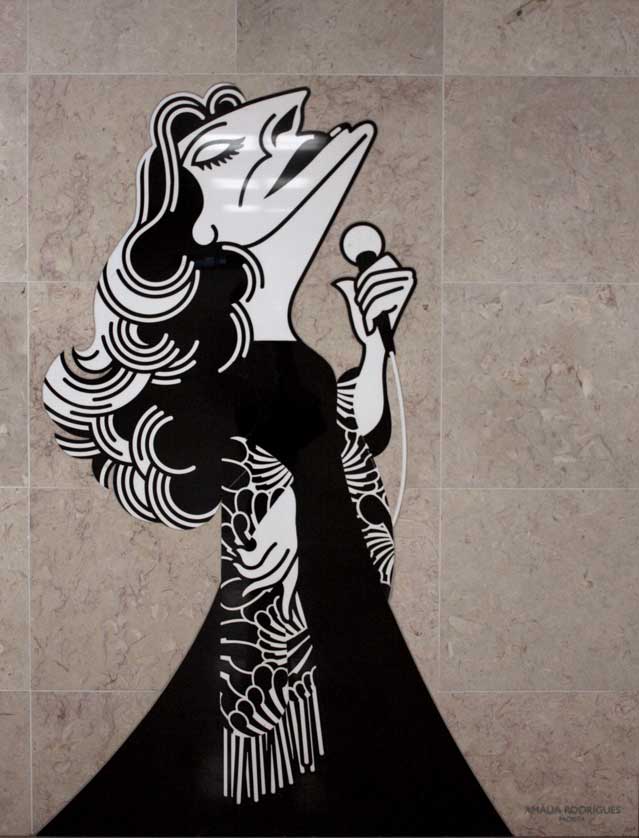
Renowned Portuguese cartoonist António Antunes was commissioned to decorate the walls of the Aeroporto subway station. His vibrant murals feature beloved pop culture figures such as Fado singer Amália Rodrigues, football legend Eusébio, architect Pardal Monteiro, artist Rafael Bordalo Pinheiro, as well as cultural icons Almada Negreiros, Fernando Pessoa, Alexandre O'Neill, Agostinho da Silva and the Nobel Prize laureate in Literature José Saramago. These larger-than-life artworks greet visitors as they come and go at the busy station. Altogether there are 53 figues in all.
Lisbon Metro Maps
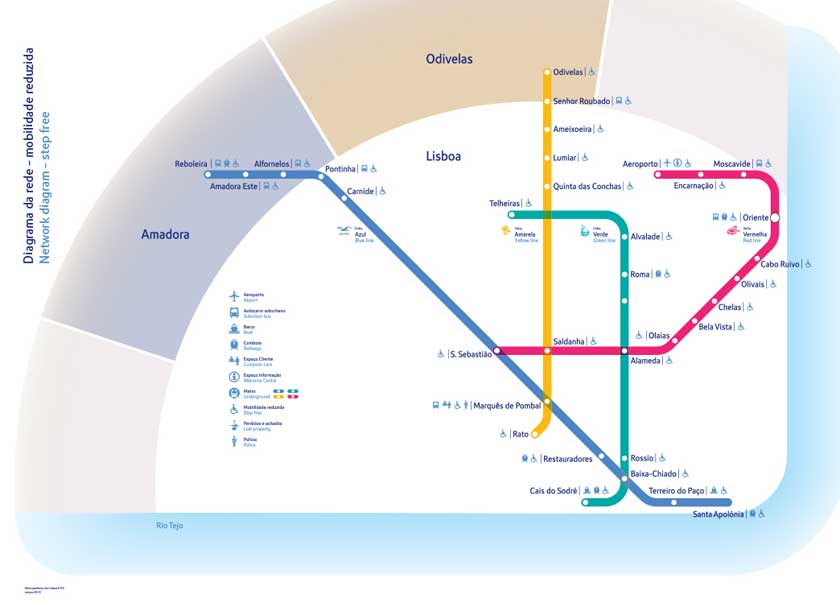
Download and print official maps of the Lisbon metro including a diagram map of the Metro de Lisboa network and the Metro network on a city map of Lisbon showing the major attractions and places of interest in the city as well as hospitals, government offices and colleges.
Metropolitano de Lisboa (www.metrolisboa.pt)
Call Center: 213 500 115
Accessibility
Not all stations on the Lisbon metro network are yet barrier free. See the map below or download it from the link above.