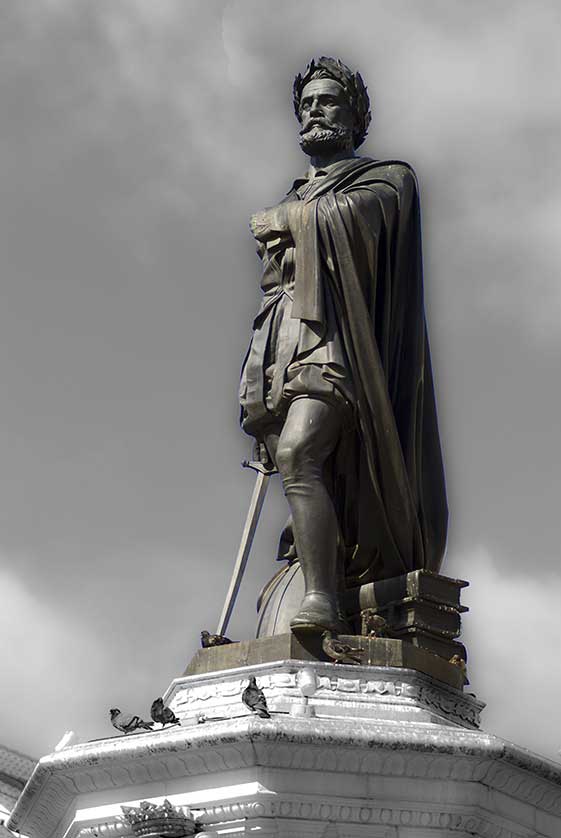
Famous Portuguese People: Luís de Camões
Luís de Camões (1524-1580) is Portugal's greatest lyrical poet. A contemporary of Shakespeare, Camões is best known for his epic work Os Lusíadas (published in 1572).
Camões was probably born in 1524, though his birthplace remains unknown. We do know that he attended the university in Coimbra and his education included a knowledge of Latin, Greek and Castilian - a language in which he later wrote.
Camões' life was as colorful as the characters depicted in his verse. It is rumored that he fell in love with one of the Queen's ladies-in-waiting and was banished from Lisbon, washing up in an ill-fated campaign in North Africa, where he lost the sight in one eye in battle.
After serving time in prison in Lisbon for wounding a member of the Royal Stables in a brawl, Camões left Portugal for the colony of Goa, where he also saw active military service in the navy and was imprisoned for a while for debt. It was in India that Camões seriously begins his work as a poet and writer.
Further adventures continued in Macau, where Camões began Os Lusíadas, took a Chinese lover and was shipwrecked on his return to Goa. Camões supposedly swam ashore after his shipwreck in the Mekong Delta holding his manuscript of Os Lusíadas above the waves.
Camões returned to Lisbon in 1570 and his most famous work was published two years later. The poem celebrates the Age of Discovery that brought fame, prestige and wealth to the country.


Os Lusíadas, in particular, praises the voyages of Vasco da Gama, which made possible the poet's life of adventure overseas, and was hailed as a masterpiece throughout Europe. Later under the rule of the dictator Salazar, the poem was held up as an icon of Portuguese nationalism.
The Museu Luís de Camões in Macau lauds the achievements of one of Portugal's greatest talents.
Camões died on June 10, 1580 and that day is now celebrated as a national holiday - Portugal Day (Dia de Portugal, de Camões e das Comunidades Portuguesas). The day is also marked by the Portuguese diaspora living overseas in the USA, Canada, UK etc.