Bridges In Portugal
Portugal's Best Bridges

The major rivers in Portugal include the Tagus, the Douro, the Guadiana, Minho and Lima. All have their source in neighboring Spain. Purely national rivers are the Mondego, the Vouga, and the Sado.
The Tagus famously flows through the capital, Lisbon, the Douro reaches the sea in Porto, the Guadiana in Vila Real de Santo António, the Minho near Caminha and the Lima in Viana do Castelo.
The Minho in the north and Guadiana in the east form part of the border with Spain.

History of Bridges in Portugal
Bridge building in Portugal began with the Romans and continued during the Moorish period. Later Medieval bridges include the 14th-century Barcelos Bridge and Ponte de Lima, 26 km upstream on the River Lima from Viana do Castelo.
Industrialization and new technology saw the creation of the Ponte Dom Luís I Bridge across the Douro in Porto in 1886, the Ponte 25 de Abril (25th of April Bridge) in Lisbon across the Tagus in 1966 and the Vasco de Gama Bridge, also in Lisbon in 1998.
See a listing of some of Portugal's best bridges both historic and modern.

Ponte 25 de Abril, Lisbon
The huge Ponte 25 de Abril (25th of April Bridge) is a major landmark in Lisbon and towers above the Alcântara area of the capital. The bridge connects Alcântara on the north bank with Almada and the statue of Cristo Rei on the south bank at the narrowest part of the River Tagus.
The Ponte 25 de Abril Bridge has a total length of 2,277 metres which places it presently in the 50 top longest suspension bridges in the world. The structure carries trains and cars and has a toll for the northbound route only. Around 150,000 cars and over 150 trains cross the bridge daily on the two rail tracks and 6 car lanes.
The bridge opened in 1966 and connects the 2.3 km between the northern and southern banks of the Tagus River. It was the first bridge to span the river, before that ferry was the only way to cross.
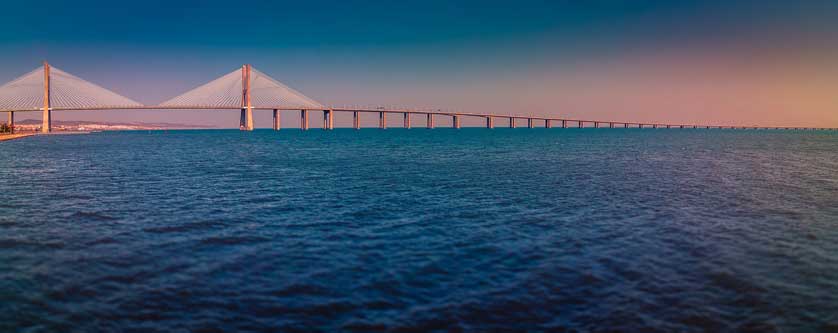
Vasco da Gama Bridge, Lisbon
The massive Vasco da Gama Bridge in Lisbon stretches 17 km from the Parque das Nações to Alcochete and Montijo on the south bank of the River Tagus.
Vasco da Gama Bridge is the longest bridge in western Europe and second behind the Crimean Bridge in Europe as a whole.
The bridge opened in 1998 in time for Expo 98. It is named after the navigator and explorer Vasco da Gama, one the great names of Portugal's Age of Discovery.
Altogether the bridge took 18 months in the planning stage and a further 18 months to actually build. It was built in four sections each by a different construction company (Kvaerner Technology, Europe Etudes Gecti (EEG), Consultores para Obras Barragens e Planeamento (COBA) and Projectos de Pontes e Estruturas Especiais (Proponte).
The cost at the time was US$1.1 billion with the investment split between Portuguese (50.4%), British (24.8%) and French (24.8%) financing.
The bridge should last 120 years and its construction incorporates technology to withstand earthquakes, such as the catastrophic 1755 Lisbon Earthquake, as well as strong winds.
The foundations of the bridge can also withstand the impact of a 30,000 ton ship traveling at 12 knots.

Ponte Dom Luís I Bridge, Porto
The Ponte Dom Luís I Bridge is a true icon of the city of Porto and a marvel of 19th century engineering. The Dom Luís I Bridge spans the River Douro between Porto on the north bank and Vila Nova de Gaia on the south bank.
Designed by German architect, Téophile Seyrig (1843-1923), a disciple and business partner of French engineer Alexandre Gustave Eiffel (of Eiffel Tower fame), the Ponte Dom Luís I had the longest span of any metal bridge in the world when it was completed in 1886.
Originally meant for road traffic, now the upper span carries Line D of the Porto metro and a pedestrian walkway, while the lower deck is for road traffic and pedestrians with no fear of vertigo.
There are wonderful views over the 18th century skyline of Porto including Porto Cathedral and the Torre dos Clerigos from the top deck and from near Jardim do Morro metro station.

Ponte de Lima, Minho
Historically, Ponte de Lima was on the Roman road from Braga to Santiago de Compostela.
The first bridge across the river was indeed Roman in origin and several arches of this bridge survive on the northern bank of the Lima.
The initial Ponte Romana was expanded in the 14th century and its graceful 13 granite arches are now the town's main attraction. The bridge is illuminated at night.
The bridge is for pedestrians only while a modern bridge downstream carries the N201 across the river.

Ponte Trajano (Trajan Bridge), Chaves
The 140 metre-long Ponte Trajano (Trajan Bridge) in Chaves in the Trás-os-Montes region of north eastern Portugal dates from the reign of the Emperor Trajan (53-117) in the early second century AD. The Emperor Trajan was known as a great promoter of public works including the Trajan Forum and Trajan Column in Rome.
The bridge over the River Tâmega is now pedestrianized and is one of the finest Roman bridges in Portugal, though it has undergone many restorations and repairs over the ages.
The bridge now has 12 arches (it previously had an estimated 18) and was once part of the Roman road from Braga to Astorga in Spain, when Chaves was known as Aquae Flaviae. There are milestones on the bridge with distances to the Roman settlements at Braga and Leon (Legio) in Spain.
Two columns from the Roman period stand on the bridge and have inscriptions. The first column is known as the Padrão dos Povos (People's Standard), dates from 79 AD and is dedicated to the Roman emperors Vespasian and Titus as well as other notables. The second column has a shorter inscription referring to the fact that the bridge was built by the local people and dedicated to Trajan.

Ponte de Santa Clara, Coimbra
The Ponte de Santa Clara spans the Rio Mondego in Coimbra and is the oldest of the three bridges crossing the river in the city.
The Ponte Europa (Rainha Santa) and the Ponte de Acude are the other newer two bridges.
The bridge was designed by Edgar Cardoso (1913-2000) and opened in 1954. It was built during the Novo Estado period under Salazar. Cardoso also worked on two bridges in Porto, the Ponte de São João and the Ponte da Arrábida.

Ponte Velha, Silves
The Ponte Velha (Old Bridge) in Silves on the Algarve is sometimes referred to as the "Roman Bridge". However, it actually dates from the mid-14th or even 15th century.
Spanning the River Arade, the bridge is now pedestrianized and is 76 meters long and 5 meters wide.
It is possible that Silves did, indeed, have a bridge in Roman times, as the city was at a crossroads of Roman roads. Also, opus signinum, a Roman construction material, has been discovered close to the bridge.
There is no written, historical evidence of a bridge in the city during the time of Moorish control. The first written reference to a bridge in Silves is from the Cortes de Lisboa in 1439. Other documents indicate that the bridge was still under construction in 1459 but that in 1473 it was already completed.
The bridge was restored in the 17th century but retained its original form. In 1950 a concrete bridge was built nearby, and the old bridge became a pedestrian bridge. Some of the construction techniques used in the bridge's arches are similar to those of Silves Cathedral.

Ponte Romana, Tavira
The Ponte Romana (Ponte Antiga) in Tavira on the Algarve is so called as it was built over the remains of an earlier 3rd century Roman bridge on the old Roman road from Faro to Castro Marim.
The present bridge over the River Gilao dates from 1663. The bridge has seven arches and green, iron railings. It is now for use only for pedestrians and cyclists after flood damage in 1989.

Ponte Rodo-Ferroviária de Valença
Two bridges now link Tui in Galicia, Spain and Valença in Portugal over the River Minho. The Eiffel-inspired road and railway bridge, the Ponte Rodo-Ferroviária de Valença dates from 1886 with a later road bridge to the south. The older 318-meter-long bridge is also referred to as the Ponte Internacional Tui-Valença, the Ponte Internacional de Tui or Ponte de Valença.

Ponte do Laço, Aveiro
The Ponte do Laço (Circular Pedestrian Bridge) in Aveiro is a steel, pedestrian bridge spanning the Canal de São Roque and the Canal dos Botirões. It was designed by the architects Luís Viegas and Domingos Moreira and opened in 2006.

Ponte 516 Arouca
The Ponte 516 Arouca is the highest pedestrian suspension bridge in the world. Opened in 2021, the bridge is 516 meters long, hence the name, and located in the Arouca Geopark, south of Porto. It spans the River Paiva, 176 meters below, from the Aguieiras Waterfall to Paiva Gorge. Arouca Geopark is a mecca for outdoor enthusiasts with canoeing, kayaking, and rock climbing all popular pastimes in the park.



Guadiana International Bridge
The Guadiana International Bridge (Ponte Internacional do Guadiana) carries the A22/A49 highway linking Spain and Portugal across the River Guadiana just north of Vila Real de Santo Antonio.
It is the third-longest bridge in Portugal and is the work of Portuguese engineer, José Luis Câncio Martins. The 666 meter-long, cable-stayed bridge (Puente Internacional del Guadiana in Spanish) dates from 1991. It stands 20 meters above the river allowing ships to pass underneath.
The road bridge is adjacent to an area of marsh and wetland - the Reserva Natural do Sapal de Castro Marim e Vila Real de Santo António and close to the Spanish town of Ayamonte.

Ponte São Gonçalo, Amarante
The picturesque Ponte São Gonçalo that spans the Tâmega River in Amarante is named after the 13th century Saint Gonçalo as is the Igreja de São Gonçalo, built on the site of his hermitage, north of the Tâmega. The bridge dates from the late 18th century and was the scene of heroic resistance by the townspeople against the invading French in the Peninsular War.

Ponte de Barcelos, Barcelos
The 14th century Ponte de Barcelos in Barcelos in the Minho spans the Cávado River. It connects the pottery-producing town of Barcelos to the north and the much smaller civil parish (freguesia) of Barcelinhos to the south. The bridge has been restored over time and has five arches.

Ponte de Ponte da Barca, Ponte da Barca
The medieval Ponte de Barca in Ponte da Barca in the Minho gives the town its name and crosses the Lima River. The bridge (Ponte de Ponte de Barca) dates from the 15th century and is modeled on the more well-known bridge in Ponte de Lima (see above). A National Monument, it is 80 meters long and has 10 arches.
Bridges in Odemira
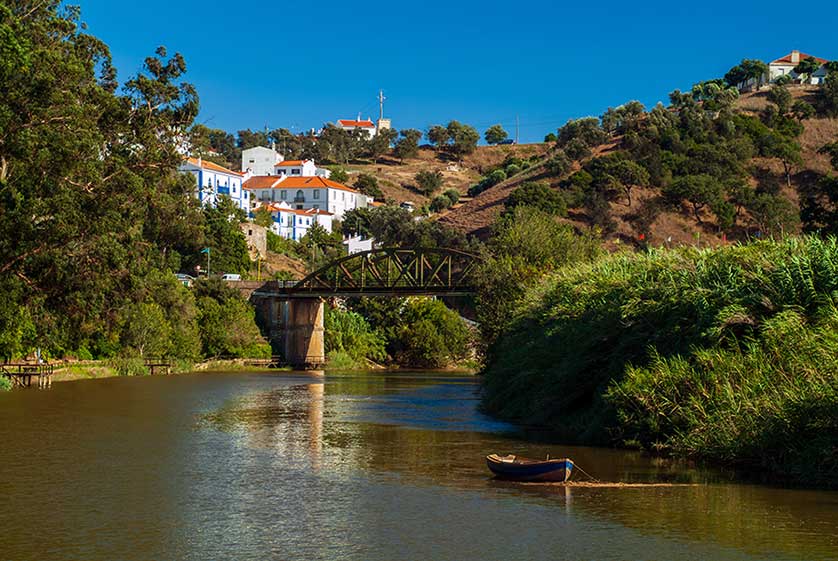
In Odemira in the Alentejo, two bridges span the River Mira in the town. They are the Ponte de Odemira dating originally from the late 19th century and the much more recent Ponte Pedonal de Odemira, a pedestrian bridge which is beautifully illuminated at night.

Other Notable Bridges in Portugal
The 560-meter long Ponte Eiffel crosses the Lima River in Viana do Castelo. It is a multi-level road-rail bridge and was designed by the famous Gustave Eiffel of Eiffel Tower in Paris fame. The bridge opened in 1878.
The Ponte da Ajuda is a ruined bridge dating from the time of King Manuel I. It crossed the Guadiana River south of Elvas.
The Segura Bridge is a partially Roman bridge over the River Erges, a tributary of the Tagus between Portugal and Spain. Of its five arches, two are Roman, the ones closest to the river banks. It is east of the town of Castelo Branco.

The Arrabida Bridge traverses the Douro in Porto. The six-lane, concrete road bridge opened in 1963. It is west of the more famous Ponte Dom Luís I Bridge.
Two other bridges in Porto east of the Ponte Dom Luís I Bridge are the Ponte de Dona Maria Pia Bridge and the Ponte de São João. The former is an iron railway bridge built in 1877 by Téophile Seyrig and Gustave Eiffel but is no longer used as such. The latter, designed by Portuguese engineer Edgar Cardoso in concrete, replaced it in 1991. Altogether Porto has six bridges across the River Douro.


Lisbon Stay
Hotels in Portugal - Booking.com
Hotels in Lisbon - Booking.com
Lisbon Hop-On Hop-Off Bus, Tramcars, and Yellow Boat River Tour