Convent of São Pedro de Alcântara
The Convent of São Pedro de Alcântara (Convento de São Pedro de Alcântara) in the Bairro Alto district of Lisbon dates from 17th century.
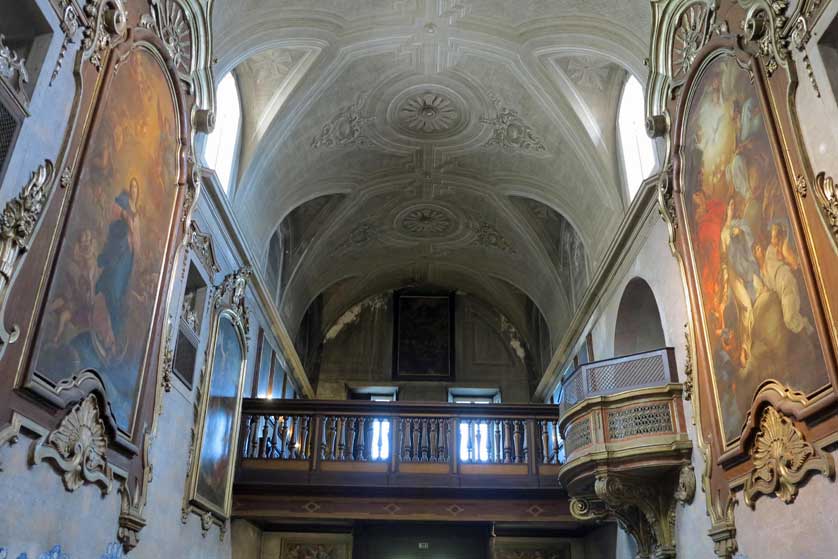
It is a quiet, peaceful church with some fine religious paintings, azulejos tiles and gilt woodwork.


History
The church dates from 1681 and was constructed as a result of a promise. This was made by the Marquis of Marialva, the Count of Cantanhede. On the eve of the Battle of Montes Claros (1665) during the War of Restoration against Spanish forces, the Marquis promised to build a convent dedicated to Saint Peter of Alcântara, if the Portuguese were victorious.
The Portuguese did indeed emerge as victors, Marialva kept his promise and received royal authorization in 1670 to build a convent for Capuchin Franciscan monks.
The church survived mostly unscathed from the 1755 Earthquake.
The church was given to the Santa Casa da Misericórdia de Lisboa in 1833.

Architecture
The church is Baroque in design and has a number of fine azulejos tile wall panels and marble floors.
On entry up stairs at the side of the church, off to the right is a small chapel with tiled walls, the Chapel of the Lencastres. It was built in memory of Veríssimo de Lencastre, Archbishop of Braga, a cardinal and Grand Inquisitor of Portugal. His grave is contained within the chapel.
The interior of the church is noted for its gilt wooden altars with Franciscan iconography. The painted ceiling in tromp l'oeil is by the French artist Pierre Bordes and dates from 1878.
Other noted paintings are The Crowning of the Virgin by Pierre Antoine Quillard and The Preaching of St John the Baptist by Pedro Alexandrino de Cavalho.


The side walls have Baroque tile panels depicting the life of Saint Peter of Alcântara, a Spanish Franciscan friar canonized in 1669. Interestingly, he is the patron saint of night watchmen, as he slept so little and watched over his fellow priests.
The painting in the high altar is The Ecstasy of Saint Peter of Alcântara by the Portuguese painter Bento Coelho de Silveira.

Access & Hours
Instituto São Pedro de Alcântara
Rua Luisa Todi, 1
1200-245 Lisbon
Tel: 213 235 233 (Tour bookings)
Hours: October - March; Monday 2 pm - 6 pm; Tuesdays - Sunday 10 am - 6 pm. April - September; Monday 2 pm - 7 pm; Tuesdays & Wednesdays 10 am - 7 pm; Thursdays 10 am - 8 pm; Friday - Sunday 10 am - 7 pm.
Closed 1 January, Easter, 1 May, 25 December.
Admission: Free
There are guided tours for a small fee on Fridays 11.30 am (French) and 3 pm (English). There are two tours in Portuguese at 3 pm and 4.30 pm on Saturday.
The Convent of São Pedro de Alcântara is close to the Church of São Roque, the Museum of São Roque and stands opposite the Jardim de São Pedro de Alcântara, with its fine views of the city, day and night, as far as Alfama, Lisbon Castle and the Tejo from the viewpoint.
The nearest Lisbon metro stations are Rossio and Restauradores and visitors can then reach the area on the Elevador da Glória. Baixa-Chiado is also reasonably close to the south.
Alternatively take either of Lisbon buses: #202 or #758 or tram #24E.
Lisbon tram #28E also passes close by.
The street where the church stands is named after the famous 18th and 19th century opera singer Luísa Todi.
