Church of São Roque, Lisbon
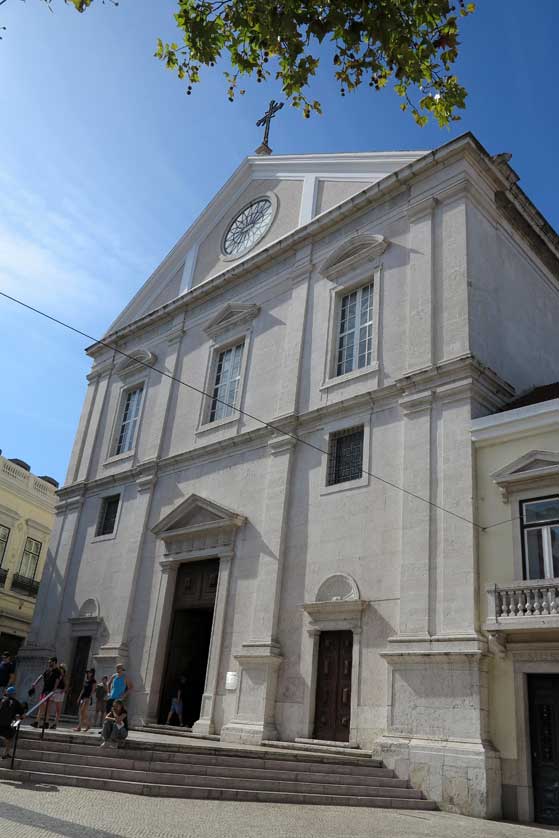
The Church of São Roque (Igreja de São Roque) is a masterpiece of a church in the Chiado district of Lisbon.
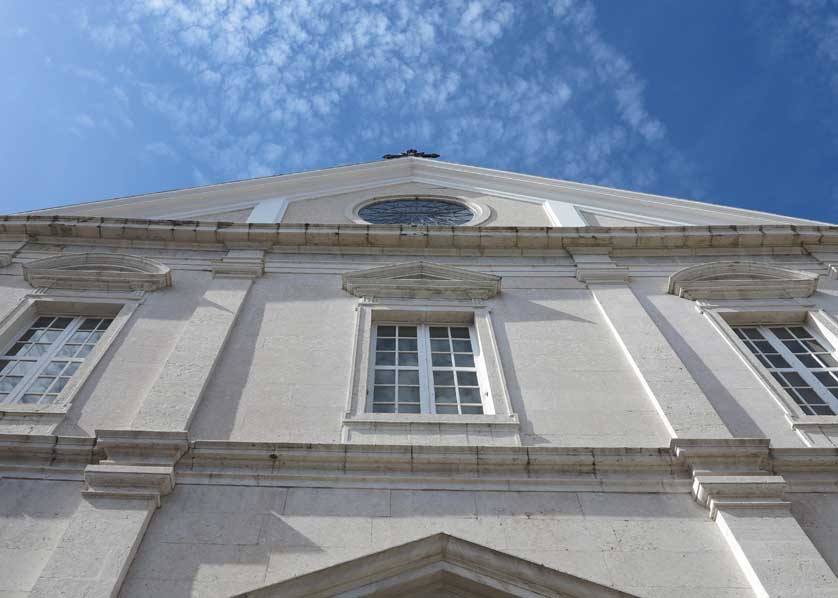
It hides some superb treasure behind its rather plain 16th century Jesuit exterior.
History
The history of the church goes back to an outbreak of the plague in Lisbon in 1505. The deadly disease was brought to the city on a Venetian trading vessel. The following year King Manuel I asked for a holy relic of St. Roch from Venice to seek the saint's protection. St. Roch is invoked in particular against the plague.
A small hermitage was built to house the relic where the present church now stands.
In 1540 the Jesuits arrived in Portugal at the invitation of King John III. They choose the hermitage for their first church and seminary and the land was ceded to them in 1553. After some time the original hermitage was demolished and a new church built. It too was dedicated to St. Roch or São Roque in Portuguese.
The church then served as the headquarters of the Jesuit Order in Portugal until they were expelled in 1759.
In 1768 the church was granted to the Santa Casa da Misericórdia de Lisboa.
The building of the Jesuit church was supervised first by the royal architect Alfonso Álvares, his nephew Balthazar Álvares and then Filipe Terzi.
Layout of the Church
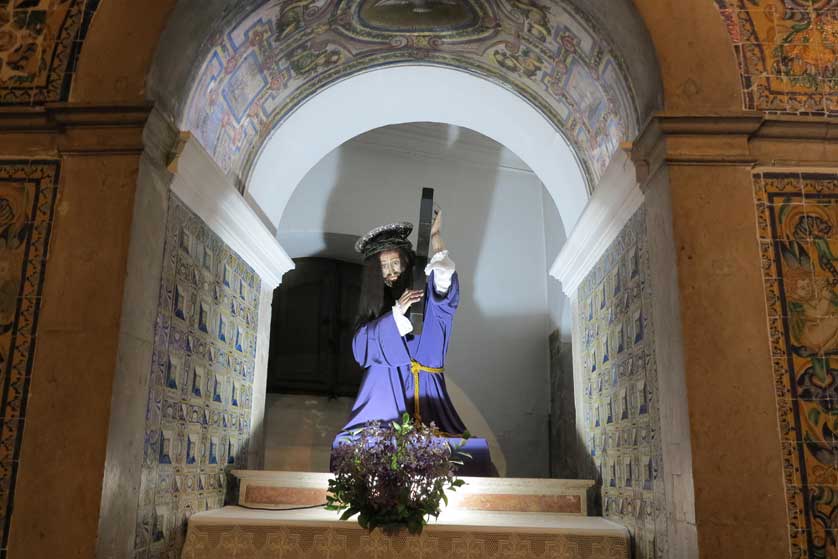
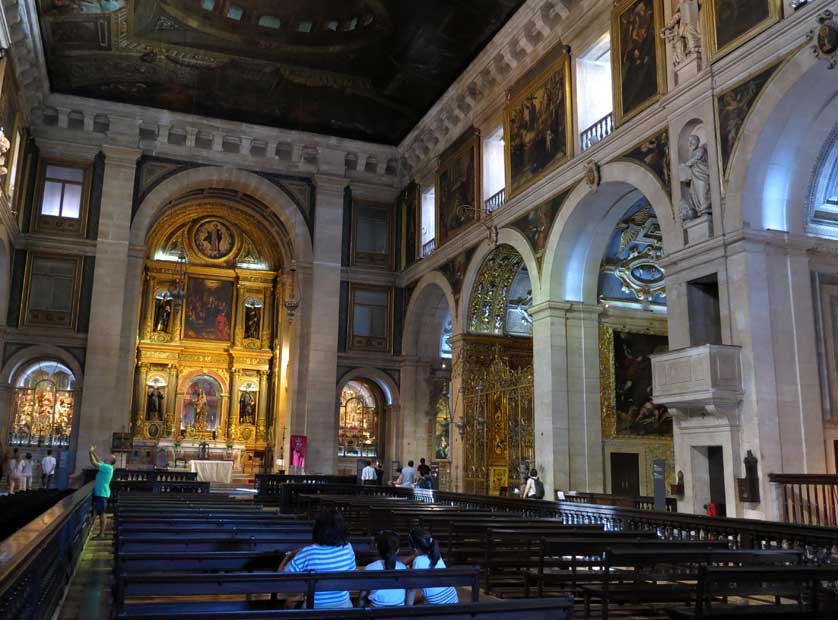
The church has a single nave, a chancel and eight side chapels.
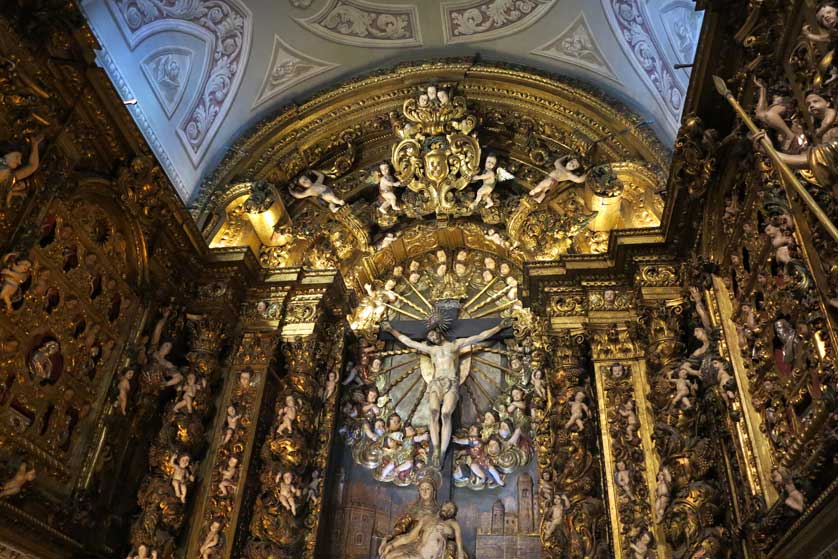
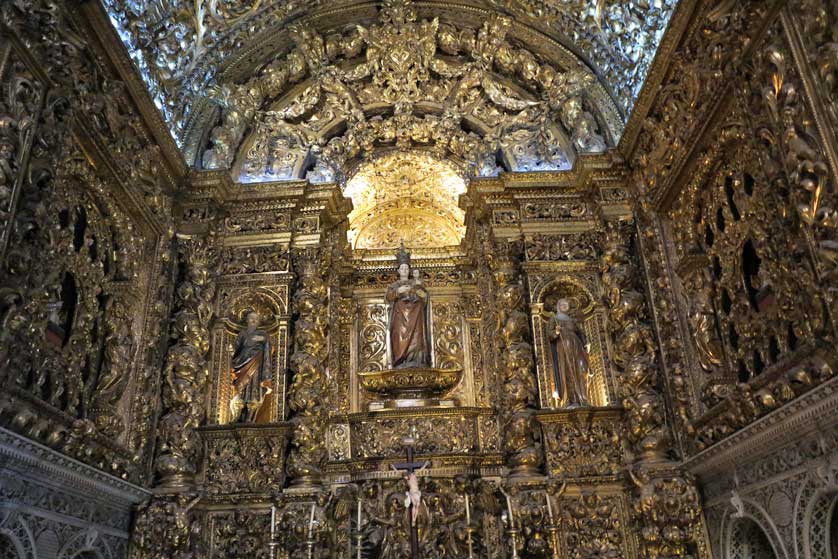
The extravagant decoration of the interior took place in stages bankrolled by the wealth coming in to the country from its overseas possessions in Brazil, Macau and India.
The ceiling is Lisbon's only example of a painted ceiling in the Mannerist style. It is by Francisco Venegas with the central medallion by Amaro do Vale.
The Sacristy off to the left from the Chancel contains 20 painted scenes of the life of Xavier and a chest of drawers in jacaranda and rosewood inlaid with ivory.
In the 19th century an upper gallery was added with an 18th century pipe organ.
Several bodies were involved in the decoration including the Portuguese crown, the Jesuits, the Santa Casa da Misericórdia de Lisboa and other religious institutions.
Chapels
The eight chapels (four on each side) beginning from the right side as you enter and moving in an anti-clockwise direction are as follows: the Chapel of our Lady of the Doctrine, the Chapel of Saint Francis Xavier, the Chapel of Saint Roch, the Chapel of the Most Holy Sacrament, the Chapel of Saint John the Baptist, the Chapel of Our Lady of Piety, the Chapel of Saint Anthony and the Chapel of the Holy Family.
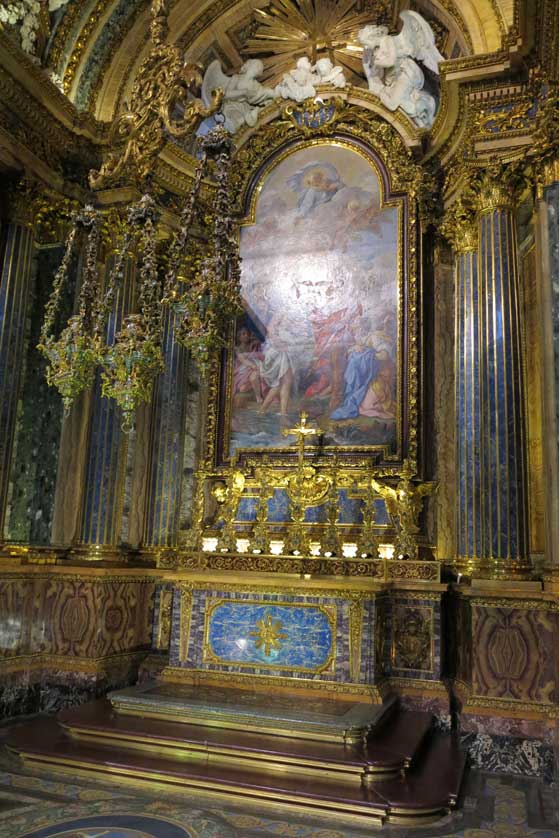
The most magnificent and expensive is the Chapel of Saint John the Baptist ordered by King John V and constructed in Rome by Luigi Vanvitelli and Nicola Salvi and then shipped to Lisbon in sections at incredible expense.
It was inaugurated in 1752 and makes use of both precious and semi-precious stones as well as gilt bronze in its design.
Chapel of our Lady of the Doctrine
The Chapel of our Lady of the Doctrine was built in Baroque style in the late 17th century, commissioned by the Brotherhood of the Doctrine.
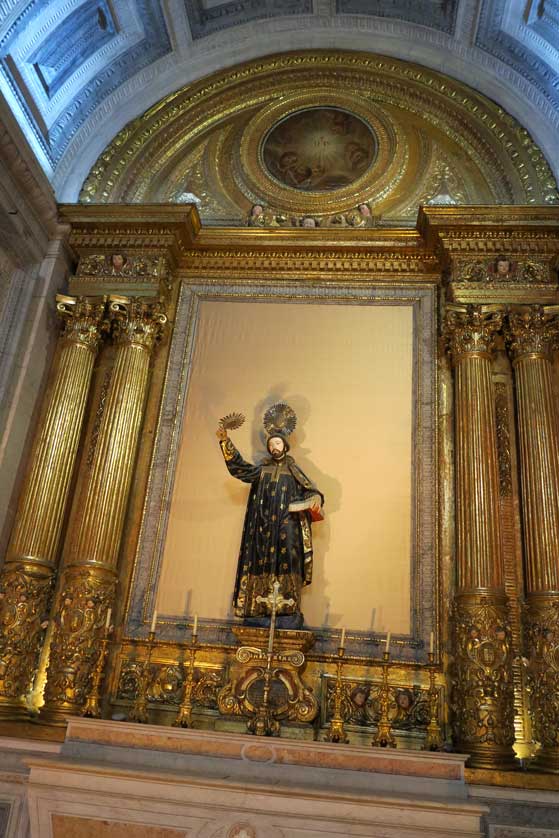
Chapel of Saint Francis Xavier
The Chapel of Saint Francis Xavier has black and white marble from the Alentejo region of Portugal with two paintings depicting the life of the saint by José Avelar Rebelo, the royal painter of King João IV.
Chapel of Saint Roch (São Roque)
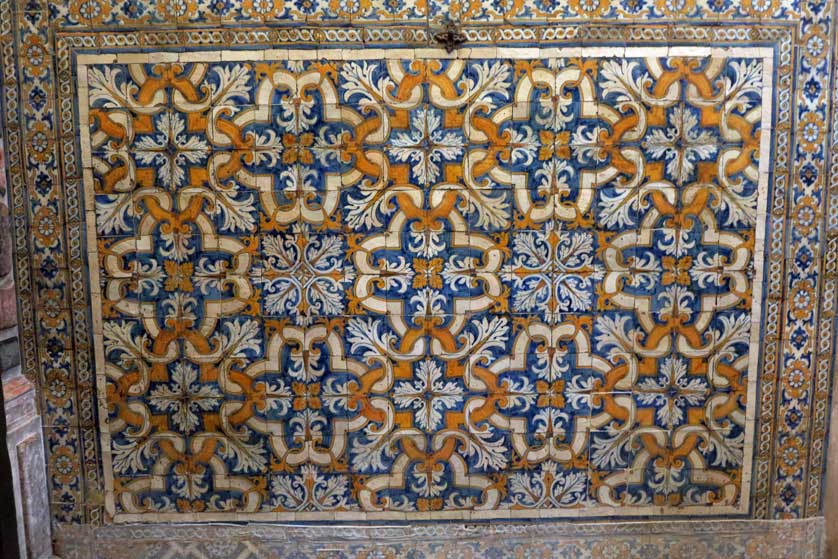
The Chapel of Saint Roch (São Roque) dates from the 16th century and includes exquisite tile work by Francisco de Matos and paintings by Gaspar Dias.
Chapel of the Most Holy Sacrament
The Chapel of the Most Holy Sacrament dates originally from 1636. This baroque masterpiece was carved by Matias Rodrigues de Carvalho and incorporates lacework, busts and marble.
Chapel of Saint John the Baptist
The Chapel of Saint John the Baptist, as mentioned above, is the most famous of the chapels. A vast team of craftsmen built the chapel in Rome between 1742 and 1747.
The central panel, The Baptism of Christ is a mosaic by Mattia Moretti, a scale model of which is kept in the adjacent Museum of São Roque along with a superb collection of golden and silver liturgical vessels and vestments that came with the chapel.
The chapel is adorned with a mix of precious and semi-precious materials: agate, alabaster, amethyst, Carrara marble, lapis lazuli, precious woods and ivory.
An early example of the new, at the time, rococo style was to have an enduring influence on Portuguese church architecture and gilt woodwork.
Chapel of Our Lady of Piety
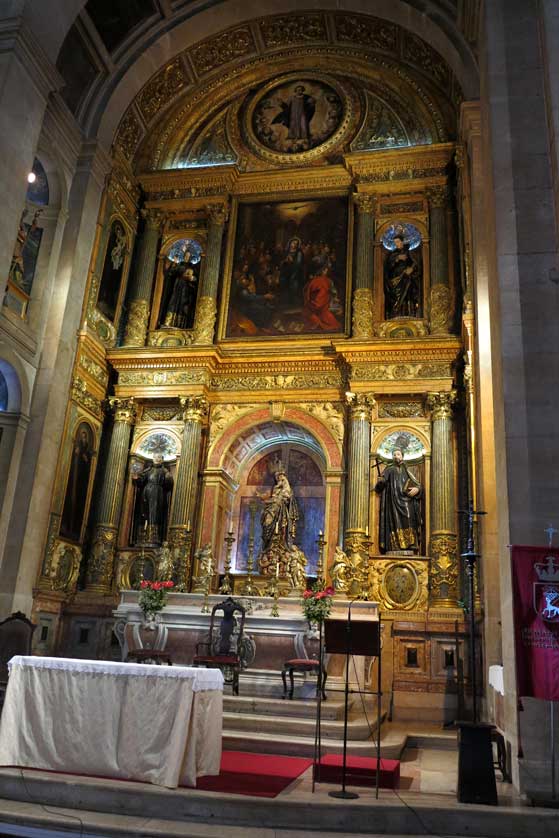
The Chapel of Our Lady of Piety also serves as the burial place of Martim Gonçalves da Câmara (1539-1613), a royal official of King Sebastian of Portugal. The central image is of "Calvary" surrounded by scores of angels and cherubs. Between the Chapel of Our Lady of Piety and the Chapel of St. Anthon, is the tomb of Francis Tregian (1548-1608), an English recusant who died in Lisbon.
Chapel of Saint Anthony of Lisbon
The Chapel of Saint Anthony dates from 1635 but was damaged in the earthquake of 1755. The chapel serves as a grave for the family of Pedro Machado de Brito, whose legacy paid for the work. The central image is a wooden statue of St. Anthony in the Mannerist style. The side paintings are by Francisco de Vieira de Matos, a Portuguese painter who trained in Rome.
Chapel of the Holy Family
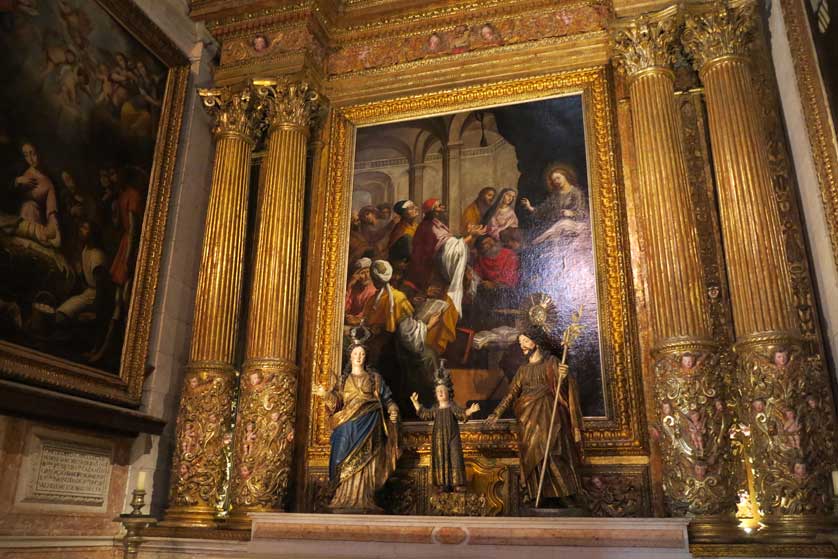
The Chapel of the Holy Family was founded by the Congregation of the Nobles and decorated in 1634. The central painting is Jesus among the Doctors of Law, attributed to José Avelar Rebelo. There are also wooden statues of Jesus, Mary and Joseph. The side paintings are by Andre Reinoso.
The chapels have explanations in Portuguese and English pointing out the main details.
Access
Largo Trindade Coelho, 1200-470
Lisbon
Hours: October - March; Monday 2 pm - 6 pm; Tuesday - Sunday 9 am - 6 pm. April - September; Monday 2 pm - 7 pm; Thursday 9 am - 8 pm, Tuesday, Wednesday, Friday - Sunday 9 am - 7 pm.
Closed January 1, Easter Sunday, May 1, December 25.
The nearest Lisbon metro stations are Baixa-Chiado, Rossio and Restauradores. The #758 Lisbon bus runs past the church as does tram #28.
Nearby
The Funicular da Gloria is just north of the church. It is also a short walk from São Roque to another much quieter church, the Convento de São Pedro de Alcântara. The Jardim António Nobre, which has great views over Lisbon as far as Alfama, Lisbon Castle and the Tagus River, is also nearby.
Accommodation in Lisbon
Hotels in Portugal - Booking.com
Hotels in Lisbon - Booking.com
Lisbon Hop-On Hop-Off Bus, Tramcars, and Yellow Boat River Tour