Portugal Regions: Baixo Alentejo
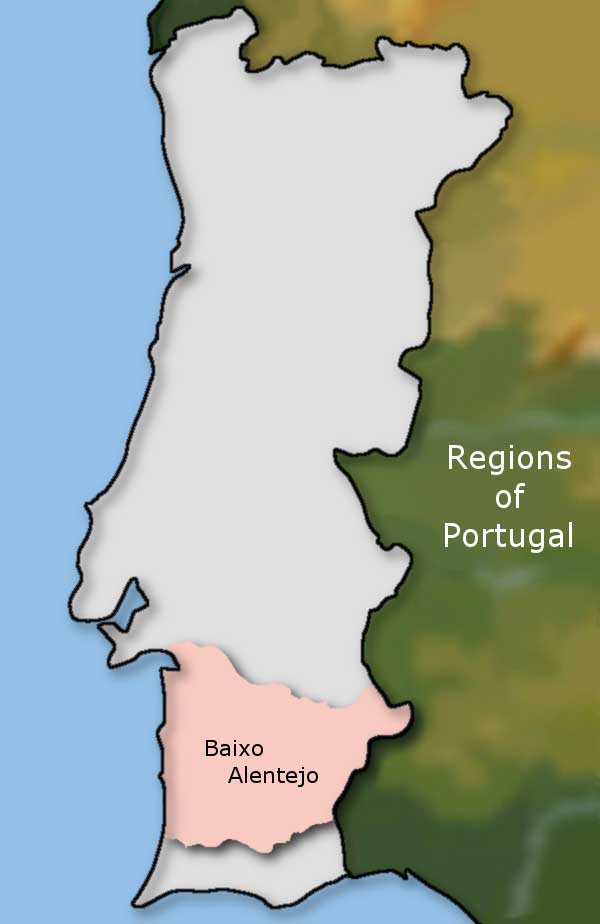
The region of Baixo Alentejo is south and east of the capital Lisbon and the name means "Lower Alentejo" to differentiate it from Alto or "Upper" Alentejo. The word Alentejo derives from além do Tejo - beyond the Tejo.
Baixo Alentejo is south of Alto Alentejo and north of the Algarve. Together with Alto Alentejo, Alentejo as a whole covers around a third of the country.
The modern A6 highway neatly divides the two "parts" of Alentejo. Taken as a whole the Alentejo is the largest province in Portugal as well as the poorest and least populated.
Main Towns
The main towns in the region are Evora, Beja, Mertola, Vila Nova de Milfontes, Moura, Grândola, Odemira, Santiago do Cacém, Castro Verde and Serpa.
The UNESCO World Heritage city of Evora is known for its Roman remains in particular the Templo Romano as well as several historic churches and Renaissance mansions. A university town, it is the largest urban area in the region with a population over 50,000.
Serpa, with a population of just 15,000 inhabitants, is now an agricultural hub for the surrounding expanses of mostly cultivated wheat. The town is also known for its lamb and a spicy, pungent cheese.

Beja, with a population of around 36,000 inhabitants, is strategically situated in the middle of the plain, though this means it becomes one of the hottest places in Portugal in high summer.
Mértola, 54 km south east of Beja, is a beautiful and historic town located at the highest navigable point of the Guadiana River, at its confluence with the smaller Oeiras River. The town is surrounded by the splendid countryside of the Parque Natural Vale do Guardiana, home to the rare black stork (Ciconia nigra).
Parts of the region are designated as a UNESCO Biosphere Reserve - the Castro Verde Biosphere Reserve.

Getting to Evora
Train Travel in Portugal
There are daily trains to Lisbon (2 hours, 30 minutes) changing at Casa Branca as well as trains to Setubal (2 hours, 15 minutes), Faro (4 hours, 30 minutes) and Lagos (5 hours). The station is south of the Jardim Publico.
Car Travel in Portugal
Evora is around an hour and a half by car from Lisbon on the A2 and the A6 highways. From Elvas or Spain (Badajoz), take the A6/E90.
Bus Travel in Portugal
The bus station in Evora is just off Avenida de Sao Sebastiao.
Fairly frequent buses make the 2 hour plus journey to Lisbon.
There are also bus connections to Elvas (90 minutes), Portalegre (90 minutes), Beja (90 minutes) and Faro (5 hours).
Portugal Hotel & Hostel Accommodation
Places to stay in Evora include the luxury Convento do Espinheiro, located in a restored 15th-century convent and surrounded by beautiful gardens. Other recommended places to stay include the five-star M'AR De AR Aqueduto, housed in a 16th century palace and the four star Vitoria Stone Hotel with pool. The reliable and friendly Hotel Dom Fernando is just south of the historic centre.
See here for a full listing of accommodation in the Alentejo region of Portugal.

Eating
The Alentejo region of Portugal is known for its delicious bread, soups and cheeses. Alentejo is the wheat-growing area of the country so you will often find its bread as an ingredient in the region's many soup dishes.
Cozido de grão is a well-known local stew of pork and chickpeas. Porco preto (black Iberian pork) appears on many menus. Vegetarians should seek out the area's delicious tomato soup.
Wines from the Alentejo area include varieties of reds, whites and rosés, though red wine is preeminent. The Alentejo area as a whole has 8 demarcated wine regions (DOC): Portalegre, Borda, Evora, Redondo, Reguengos, Videguejra, Granja Amareleja and Moura.
Evora's wines are mainly full bodied reds. The city's Adega da Cartuxa has guided wine tours. The Herdade da Malhadinha Nova in Beja is another noted winery.
Wine production in the Alentejo dates back to Roman times.
The savannah-style plains of the Alentejo are known as montado in Portuguese. They are home to a unique habitat of cork and holm oaks as well as olive trees. As well the montado provides an environment for deer and wild boar (which feed on the acorns from oak trees) as well as endangered birds such as Bonelli Eagles.
Weather
The eastern districts of Portugal, furthest from the cooling, ocean breezes, are the hottest areas of the country during the summer. In winter, the distance from the warming influence of the sea means that temperatures can drop below freezing overnight in December and January. The geography reflects the climate and the landscape much resembles Spanish Extremadura and Andalusia with thin, poor soils supporting cork oaks and olive groves.
The average high June temperatures for Portugal is between 22 degrees Centigrade and 26 degrees Centigrade.
Get more weather information for Portugal