Mosteiro de Alcobaça (Monastery of Alcobaça)

The Mosteiro de Alcobaça (Monastery of Alcobaça) is a large medieval monastery and UNESCO World Heritage Site, located in the small town of Alcobaça, not far from Leiria in central Portugal.
Along with the Monastery of Santa Cruz in Coimbra, the Monastery of Alcobaça is among the first Gothic buildings to be constructed in Portugal.
The monastery remains the largest church in Portugal with the largest cloister, though it now functions as a museum administered by the state.
As well as the Gothic base of the architecture, the monastery was embellished with later Manueline features and construction work on the buildings was ongoing over centuries.
The Monastery of Alcobaça was one of Europe's most important monasteries during the monastic age and a centre of religious study and worship for the around 1,000 monks who lived here before the dissolution of the monastic orders in Portugal in 1834.
By that time, however, the decadence of the monks had become a byword. The English millionaire, collector, writer and eccentric exile William Beckford (1760-1844), himself no stranger to sin or scandal, called the great kitchen and refectory at Alcobaça "the most distinguished temple of gluttony in all Europe" during his sojourn in Portugal in 1793.
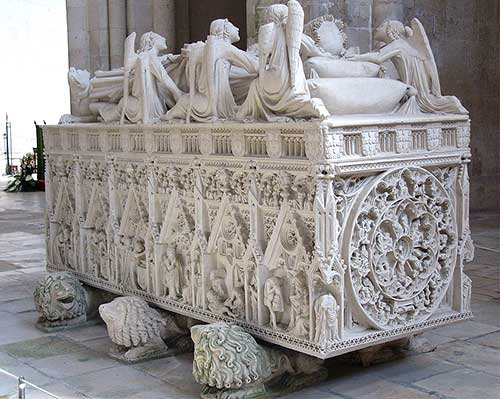
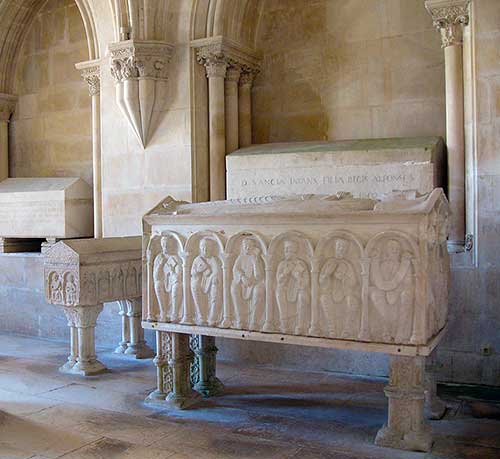
The Monastery of Alcobaça also contains the tombs of Dom Pedro and his ill-fated lover, the Spanish maid Dona Inês de Castro, who was murdered on the orders of Dom Pedro's father, King Afonso IV. Also buried here are the Portuguese monarchs King Afonso II, King Afonso III and their queens.
History
Like the nearby Mosteiro de Santa Maria da Vitória (Mosteiro de Batalha) the huge Mosteiro de Alcobaça was built to give thanks for a military victory. Not against the Castilians this time but earlier against the Moors, when Dom Afonso Henrique, the first king of Portugal, decisively defeated them at Santarém in 1147, in a victory that would change the course of Portuguese history.
The Mosteiro de Alcobaça was founded in 1153 and dedicated to Bernard of Clairvaux, the French Cistercian and later saint, who preached in favour of the Second Crusade. It was during this (generally disastrous) Crusade that an English army on the way to the Holy Land helped the Portuguese to expel the Moors from Lisbon and other towns.
Building began on the monastery in 1178 and the first stage was completed by around 1252.
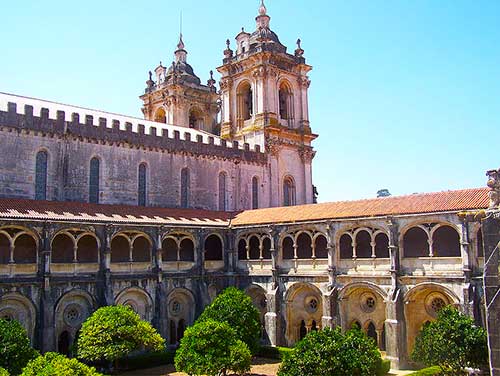
Under Manuel I, a second floor was added to the massive Claustro do Silencio (Cloister of Silence) by the architect João de Castilho and a new sacristy was built in Manueline style.
The monastery was damaged in the 1755 Earthquake and then again by French troops during the Napoleonic Wars in the early 19th century. They despoiled the tombs of Dom Pedro and Dona Inês de Castro and the library searching for loot.

Architecture
The exterior of the Mosteiro de Alcobaça is is fairly plain with a rose window in the facade, which is flanked by two later 18th century towers.
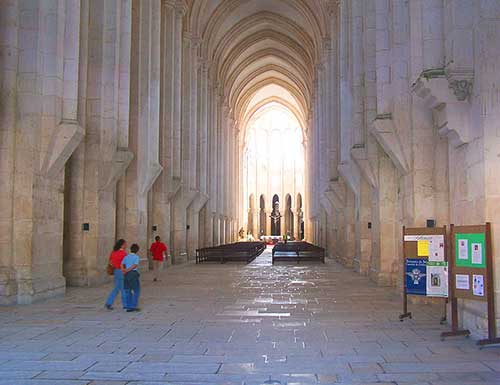
Highlights of the building include the 106m long nave which is only 23 meters wide, thus giving a greater impression of verticality. The layout of the church is that of the Latin cross featuring the main nave and transept. This part of the church includes the intricately carved royal tombs.
The Kitchen & Refectory is also on a huge scale and it was in the refectory that the monks would eat their meals in silence while listening to Bible readings from the pulpit. There is an enormous central chimney, covered in glazed tiles, and supported on iron columns. A small canal diverted water (and sometimes fish) from the River Alcoa to the kitchen.
The Claustro do Silencio is now two-storied with the 16th century Manueline upper floor with typically decorated columns capping the 14th century lower floor.
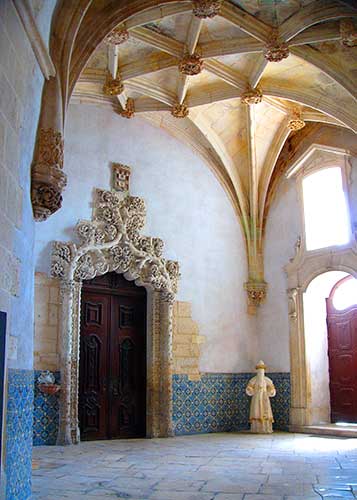
The Sala dos Reis (King's Room) has 17th-18th century statues of Portugal's monarchs lining its walls and fine 18th century azulejos that describe the history of the monastery's construction.
The monastery is still used for conferences, book fairs and other events.
Access
Mosteiro de Alcobaça (mosteiroalcobaca.pt)
Alcobaça, Portugal
Tel: 262 505 120
Hours: October to March from 9 am - 6 pm (last admission at 5.30 pm) April to September from 9 am to 7 pm (last admission at 6.30 pm) Closed: 1 January, Easter Sunday, 1 May, 20 August and 25 December.
Admission: Individual ticket: €6
Combined ticket/the Heritage Route (Alcobaça, Batalha, Convent of Christ): €15
There are buses to Batalha (30 minutes), to Nazaré (20 minutes), Leiria (45 minutes) and Lisbon (2 hours).
By car from Lisbon or Leiria take the A8 motorway and exit at Alcobaça/Nazaré/Valado dos Frades. Then take the EN 8-5 to Alcobaça. Alternatively, take the A1 motorway to Alcobaça (exit at Leiria if you're coming from the north, or at Aveiras if you're coming from Lisbon and the south).
Nearby
Other places to visit in the Estremadura region of Portugal include Batalha, Caldas da Rainha, Ericeira, Fátima, Foz do Arelho, Golegã, Leiria, Mafra, Nazaré, Óbidos, Ourém, Peniche, Santarém, Tomar, Torres Vedras and Vila Franca de Xira.