Pedro Nunes
Pedro Nunes (1502-1578) was a brilliant mathematician, cosmographer, geographer and teacher of Jewish origin.
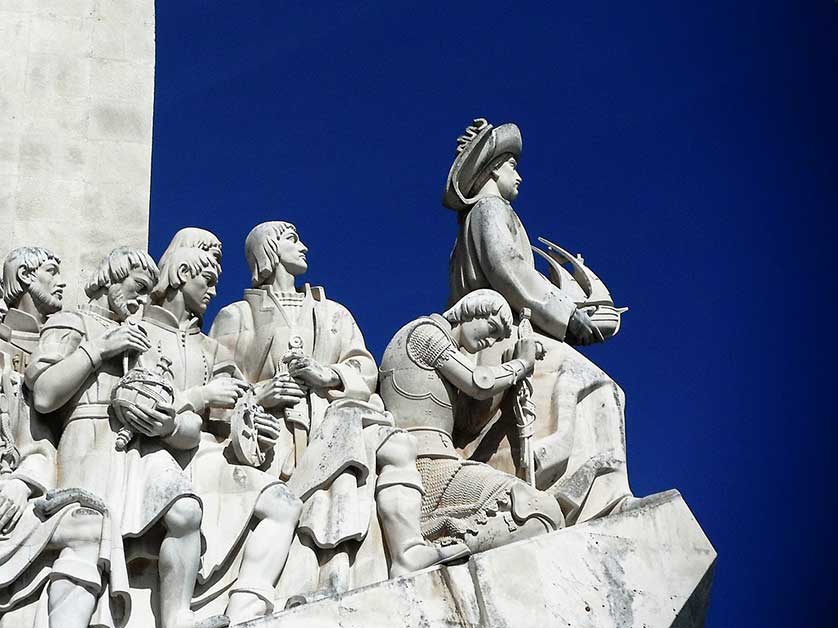
His work on navigation was important to Portugal's Age of Discovery and his statue can be seen on the Monument to the Discoveries (Padrão dos Descobrimentos) in the capital, Lisbon. He was also appointed the teacher to several children of the Portuguese royal family including the ill-fated Sebastião I.
Nunes was born in Alcácer do Sal, 52 km south east of Setúbal in 1502. Not so much is known about him as a young man though he studied at university in both Salamanca in Spain and also in Lisbon. He graduated in medicine in 1525 having also studied astrology, astronomy and mathematics.
He later taught mathematics at the University of Coimbra until 1562. As well as his chair at Coimbra, Nunes was also appointed Royal Cosmographer in 1529 and Chief Royal Cosmographer in 1547.
He published his work in Latin as well as in Portuguese and Spanish.

Writings
In his Treatise in Defense of the Marine Chart (Tratado em defensam da carta de marear) published in 1537, Nunes was the first mathematician to discuss the rhumb line or loxodrome - a spiral course when a ship maintains a steady course at sea.
His work on navigation also included inventing the Nonius - named in his honor - which is an improvement to the astrolabe. His research in this field was to lead to greater advances in navigation as other mathematicians carried on his experiments. His writings on the subject were published in De crepusculis (1542).
Pedro Nunes was part of a network of European intellectuals and maintained a correspondence with the English scholar John Dee (1527-1609).
Nunes married a woman from Spain in his youth and together they had six children. He died in Coimbra in 1578.