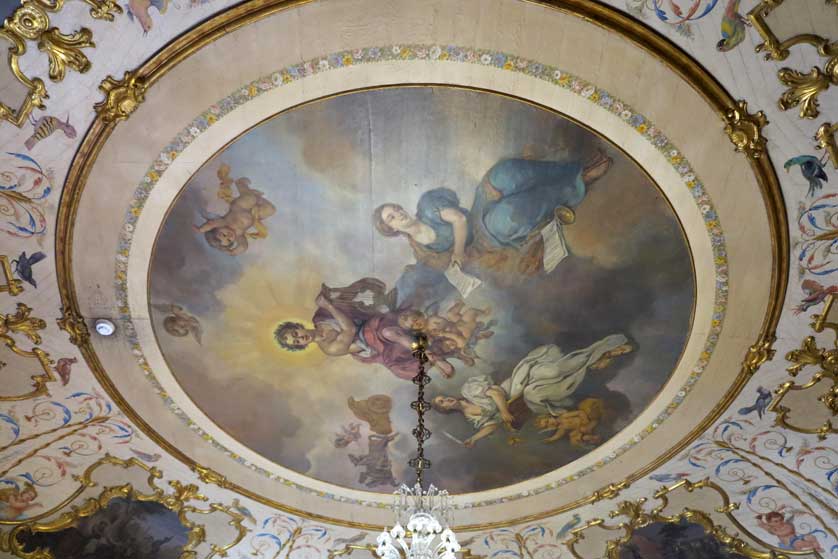
Portugal City Travel Guide: National Palace of Queluz
Queluz
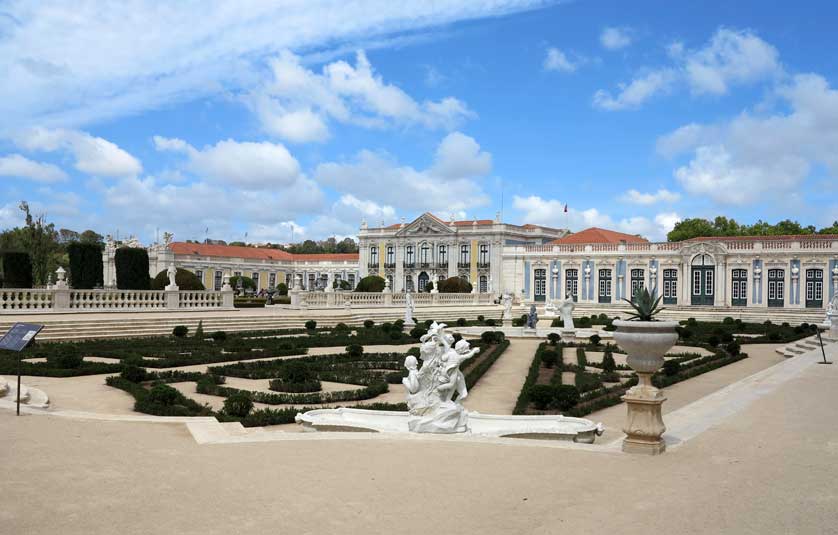
Queluz is a western suburb of the capital Lisbon. The district is most famous for the National Palace of Queluz (Palácio de Queluz) and its superb gardens.
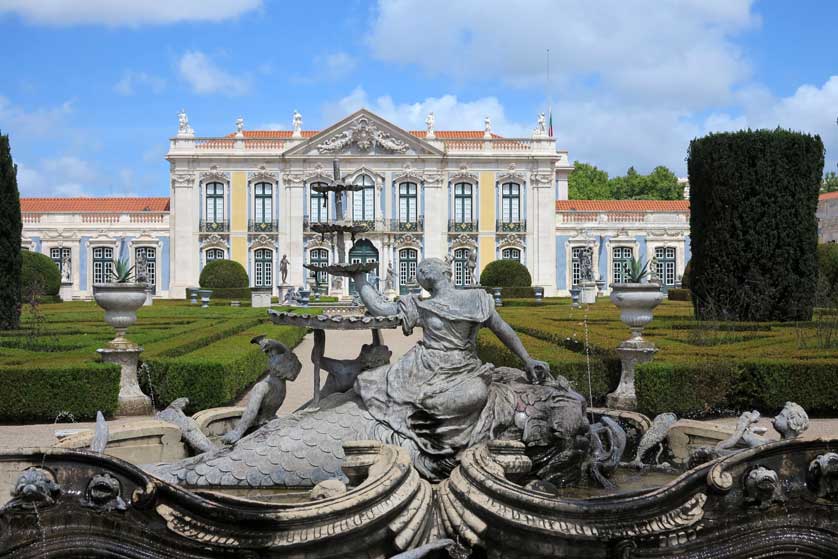
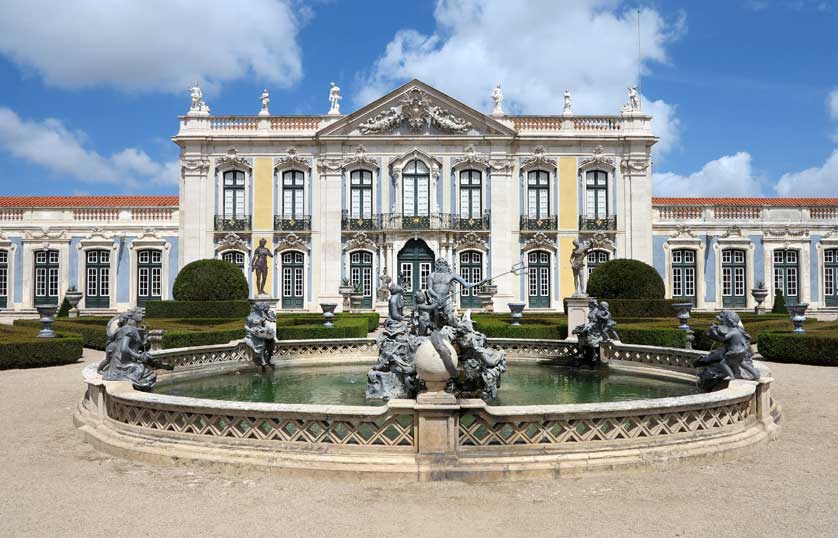
The palace is known for its fanciful, highly decorative, Rococo architecture.
The palace is an easy day or half-day trip from the center of Lisbon or north from Belém.
History
The palace was the idea of Dom Pedro of Braganza, who was to become King Pedro III as the husband of Queen Maria I.
Work began on what was originally conceived as a summer retreat for the royal family in 1747. The vast riches of Portugal's overseas territories at this time in Portuguese history, especially gold from Brazil, was poured into its construction.
Construction of the building was interrupted by the Lisbon Earthquake of 1755 and the plans were changed to make the buildings lower and better able to withstand tremors.
As Queen Maria gradually descended into insanity, the palace became a discreet place of incarceration and retirement for her.
When French forces invaded Portugal in 1807, the then Prince Regent and later king of Portugal João VI fled to Rio de Janeiro in Brazil, taking with him his mad mother, Maria, who was to die in the Convento do Carmo in Rio in 1816.
The Palace is often described as the "Versailles of Portugal" though the comparison is not really valid.
Versailles is much larger and more grand and serious, whereas Queluz is more frivolous and was described by the British author Xan Fielding as resembling "a very expensive birthday cake."
Indeed, the de facto ruler of Portugal at this time, the Marquis of Pombal, encouraged the royal family in its frivolity while he got on with running the country.
Unfortunately, a fire in 1934 damaged the palace and a least a third of the building was destroyed before being subsequently restored.
Architecture
The main architect of the site was Mateus Vicente de Oliveira (1706-1786), who had previously worked at the National Palace of Mafra.
The French architect Jean-Baptiste Robillion and de Oliveira's former tutor was responsible for the gardens and interiors.
The public, entrance façade of the palace consists of symmetrical, quadrant wings with a statue of Queen Maria I in the semi-circular cour d'honneur. This façade is the most austere part of the palace.
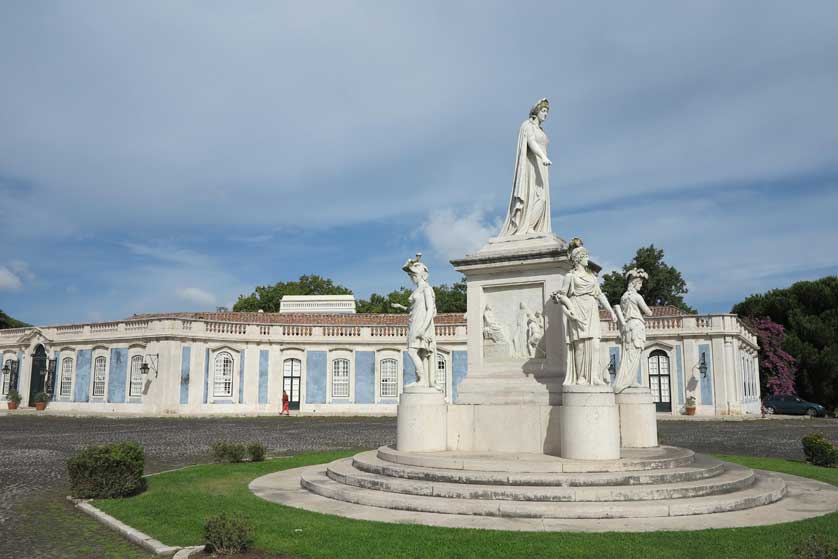
The Dona Maria Pavilion completed in 1798 is the most recent wing of the palace. It is now used as accommodation for visiting heads of state.
Art Works
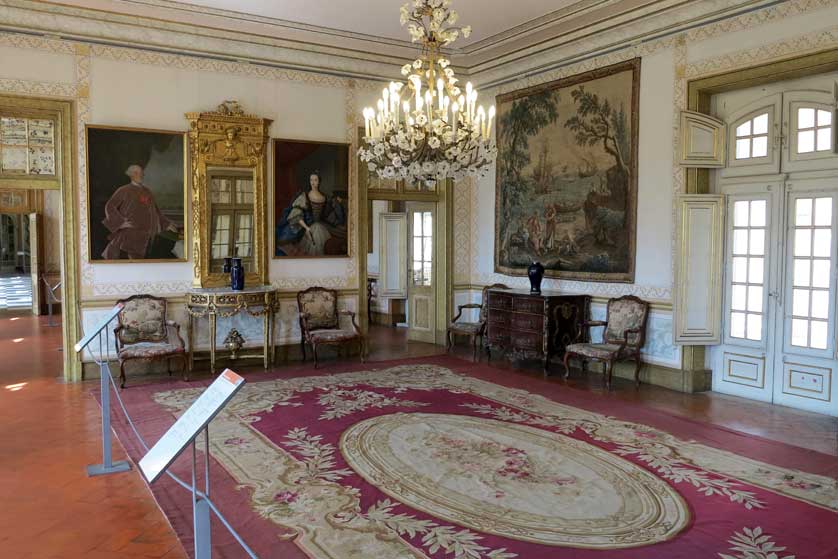
The palace is treasure trove of 1000's of works of art.
These include paintings and azulejos tiles. Materials were imported from all over Europe and South America for the furnishings.
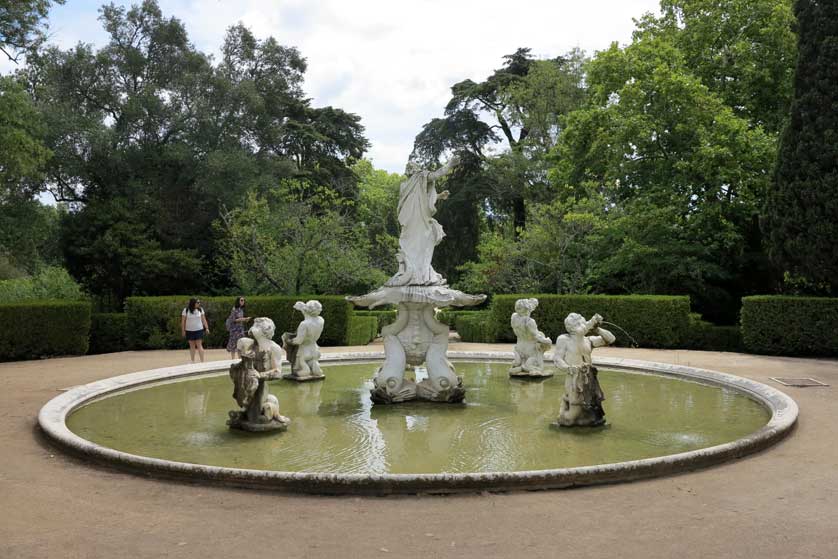
The gardens contain over a dozen statues in lead by the English sculptor John Cheere (1709-1787). They make up the largest collection of his work outside England. They were chosen by King Pedro and commission by the Marquis of Pombal. The pieces were restored by the World Monuments Fund between 2003 and 2009. The mainly classically-inspired sculptures include Cain and Abel, Apollo, Diana, Mars and Minerva as well as representations of Spring, Summer and Autumn.
Rooms
The National Palace of Queluz contains many fine rooms and series of rooms.
Some highlights include the Music Room, decorated with gilded and painted wood and the Chapel, both the work of de Oliveira. The chapel has an octagonal single nave and a choir. The exterior onion-shaped chapel dome is coated with copper plate.
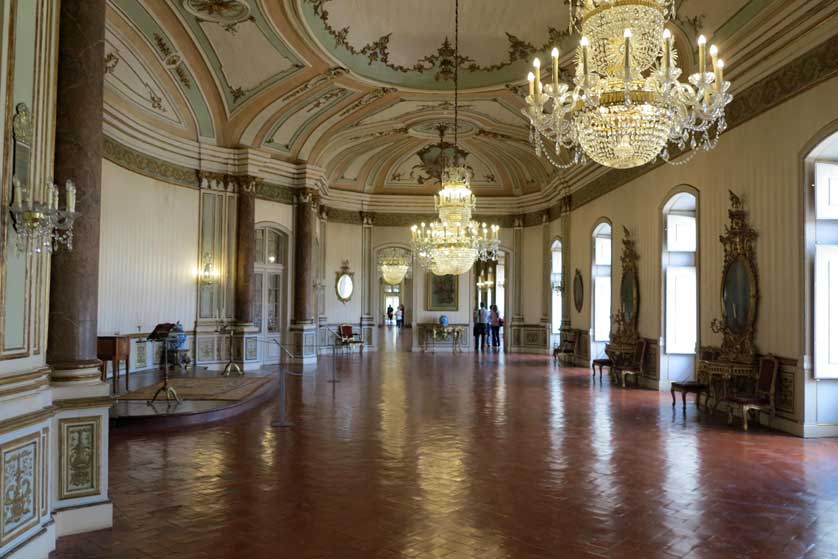
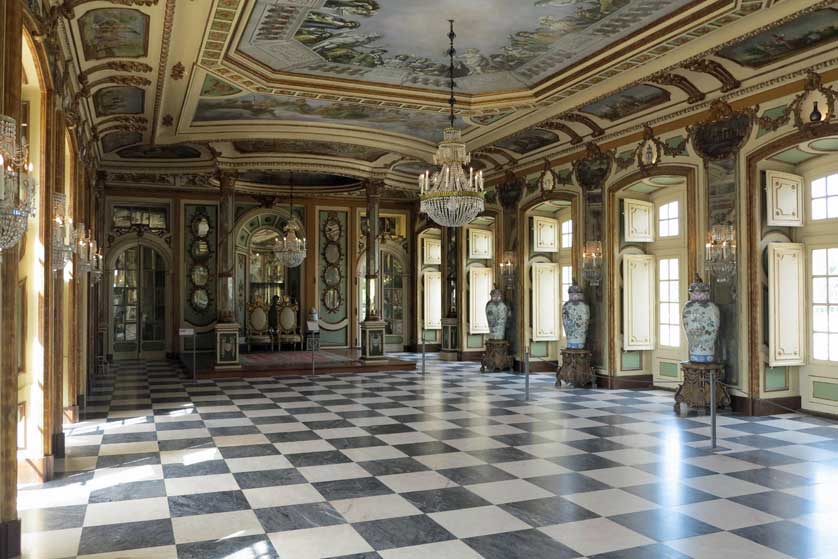
The Hall of the Ambassadors is another series of ornate rooms in the so-called Robillion wing, as this wing was the work of the French architect. After the 1755 Earthquake, Mateus Vicente de Oliveira was called away to help with the reconstruction of Lisbon by Pombal.
The room contains several large scale Chinese porcelain vases and is richly decorated with mirrors.
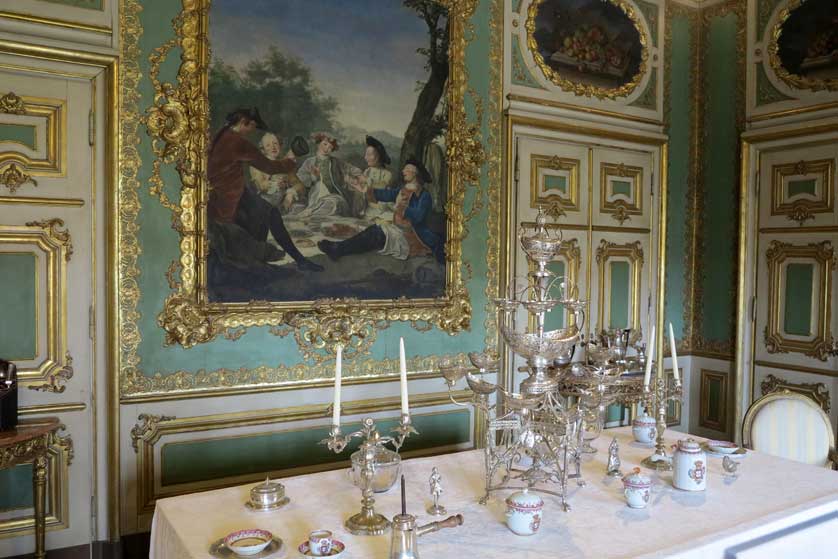
The private apartments of the palace are more sober in tone than the public rooms.
These include the Sala das Merendas, the royal family's dining room, the Queen's Boudoir and King's Bedroom. This room is also known as the Dom Quixote Room as it displays scenes from the tale of Cervantes' hero. King Pedro IV was both born and died in this room.
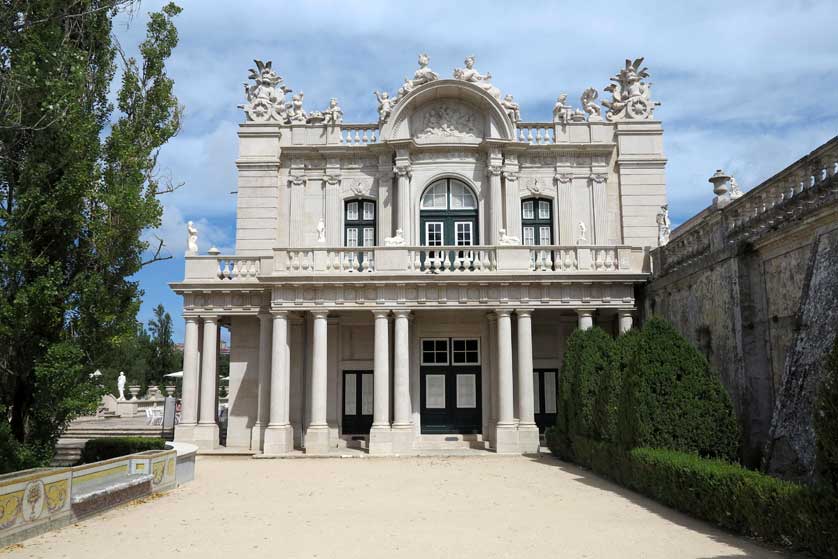
The Gardens
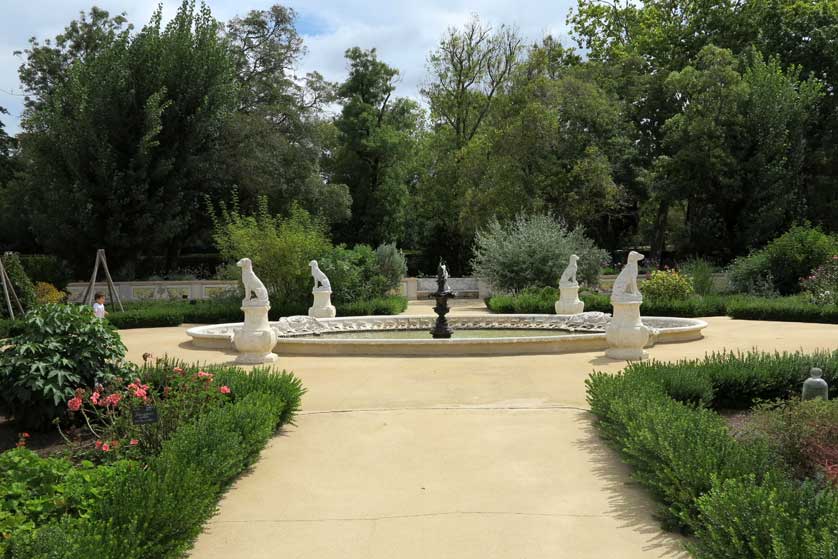
For many visitors the best part of the palace are the superb gardens.
Water was brought to the palace by two aqueducts and fed numerous cascades, lakes, fountains and waterfalls.
The Tiles Channel is a waterway lined with azulejos tiles where the royal family could enjoy gondola rides. Nowadays the canal only has water during the month of May.
The nearby House of Music was a pavilion where the royals could enjoy concerts in an outdoor setting.
Continuing in this direction through orchards is the small symmetrical Botanical Garden, laid out in the 1770's around four greenhouses for exotic plants and the cultivation of pineapples.
Other areas of the grounds include vegetable gardens, a maze and the royal stables. These are now the Portuguese School of Equestrian Art which retains original 18th century harnesses and riding costumes. Horses are still kept here from the lineage of the Alter Real Stud Farm formed in 1748 and perform at the Henrique Calado Riding Ring in Ajuda, Belem.

The New or Malta Garden and the Neptune Garden are semi-enclosed within the buildings of the palace.
The Neptune Garden contains several of the statues by John Cheere.
The gardens contain a variety of trees and bushes including cypress, magnolia, mulberry and yew.
Access - Getting To Queluz
The palace is a 20 minute walk or short taxi ride from either Monte Abraão Station or Queluz-Belas Station both on the Sintra Line (Linha de Sintra) to Sintra Station.
Heading east trains stop at Sete Rios, Entrecampos and Roma-Areeiro all of which are on the Fertagus Line to Setúbal in Setúbal.
Change at Benfica for Campolide and Rossio Station.
Sete Rios, Entrecampos, Roma-Areeiro and Rossio all connect with the Lisbon metro.
Book Accommodation in Lisbon
Lisbon boasts some of Europe's best hotels. Visitors have the choice of staying close to the historic center near Rossio and Restauradores or further afield in Sete Rios or Entrecampos, both of which have excellent transport links. Some recommended hotels in Lisbon include the five star TURIM Boulevard Hotel and the luxury Maxime Hotel on Praça da Alegria.
See a listing of hotels in Lisbon.
Some other recommendations are the Hotel da Baixa, the Eurostars Museum and the Lisbon Wine Hotel.
If you wish to stay right at the palace try the fantastic Pousada D. Maria I in the building which formerly housed the Royal Guard to the Court.
Hotels in Portugal - Booking.com
Albufeira Hotels - Booking.com
Book Hotels in Algarve - Booking.com
Find Hotels in Lisbon - Booking.com
Search Hotels in Porto - Booking.com
Apartments & Hotels in Madeira - Booking.com
Hostels in Portugal - Booking.com
Lisbon Hop-On Hop-Off Bus, Tramcars, and Yellow Boat River Tour