Florbela Espanca

Florbela Espanca (1894-1930) was a poet who packed much into a short and extraordinary life.
Espanca was born Flor Bela d'Alma da Conceição in the provincial town of Vila Viçosa near Evora in 1894.
Her mother was a young housemaid, only 15 years of age when she was born in the household of her father, João Maria Espanca, a businessman.
Her father's wife was unable to conceive children of her own and agreed to Florbela being brought up by both herself and the child's natural mother. How common was this kind of love triangle at the time we can only surmise, though around 12% of all births in Portugal at the beginning of the 20th century were illegitimate.
Her father also later on had a son with Florbela's mother - children he was to officially recognize only much later in life.
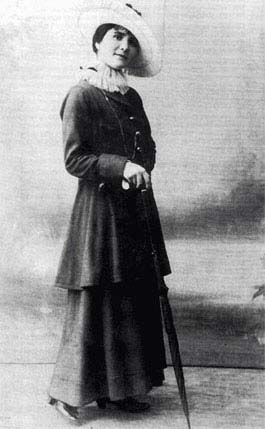
This unusual childhood no doubt influenced her subsequent views on life and love expressed in her evocative poetry. Indeed, Florbela was to hold her father in high esteem throughout her brief life.
She began writing poetry at an early age. A Vida e a Morte (Life and Death) was written when she was only eight years old. Her mother died young at only 29 in 1908 and Florbela began school in Evora shortly after.
However, she failed to graduate and dropped out of school to marry a former classmate, Alberto Moutinho, in a civil ceremony, something quite unusual at the time.
They set up a school and both began working as teachers in the area to sustain themselves, later moving back with her father due to money problems.
Her first collection of verse, O livro D'el (His Book) was dedicated to her brother in 1917.
After re-enrolling and finally graduating high school, she moved to Lisbon where she was one of only a handful of women at the time to enter the University of Lisbon, where she studied Law, in a building that is now the German Embassy. Her husband was left behind and her father paid for the tuition fees.
A series of miscarriages where to follow and the unfortunate poetess began to display signs of depression and mental ill-health. At the time of her divorce from Moutinho in 1919, she published Livro de Mágoas (The Book of Sorrows).
She married António Guimarães (also in a civil ceremony) in 1923 but yet another miscarriage lead to another divorce, after the couple began to quarrel ferociously and seemingly physically.
Espanca married a third time, this time in a religious service, to her doctor Mário Lage, and a friend of António Guimarães, in 1925. This union was probably the most tranquil of her life but it seems Espanca was also having an affair shortly before her death.
Her last collection of verse, Charneca em Flor (Heath in Bloom), expresses the poet's struggles with monogamy and her desire for free love - revolutionary ideas at the time.
Her sonnet Amar captures her desire for freedom in love.
Eu quero amar, amar perdidamente!
Amar só por amar: Aqui... além...
Mais Este e Aquele, o Outro e toda a gente
Amar! Amar! E não amar ninguém!
Recordar? Esquecer? Indiferente!...
Prender ou desprender? É mal? É bem?
Quem disser que se pode amar alguém
Durante a vida inteira é porque mente!
I want to love, to be lost in love!
To love just to love: Here... there...
This one, that one, another one,
Everyone! To love and not love anyone!
Remember? Forget? It’s all the same!...
Hold on or let go? Wrong? Or right?
Those who say they can love someone
Their whole life long are telling a lie!
The death of her brother, Apeles, in a flying accident, which may have been suicide, affected her deeply. Apeles was a pilot in the Portuguese Air Force and died in a seaplane accident in 1927.
After two unsuccessful attempts, Espanca committed suicide on her 36th birthday after an overdose of barbiturates (sleeping pills in this case) in Matosinhos, near Porto.
As she wrote in her diary that she began to keep at the end of her life: "My life! What a mess! I don't even know what I want!"
Florbela Espanca wrote mostly in the sonnet form but also contributed articles for periodicals of the time. A statue dedicated to her can be seen in the Parque dos Poetas just outside Lisbon in Oeiras.