Costume Museum (Museu do Traje), Viana do Castelo
The Costume Museum (Museu do Traje) in Viana do Castelo is the city's most impressive museum.
History
The modern museum is housed within a 1950's building that was once a branch of the Bank of Portugal designed with architectural features of the "Estado Novo" of António Salazar. It is located in the city center in Praça da República.
The museum showcases the folk costumes and traditions of the Alto Minho region with life size mannequins modeling locally-made original costumes.
The Museu do Traje opened in 2002.

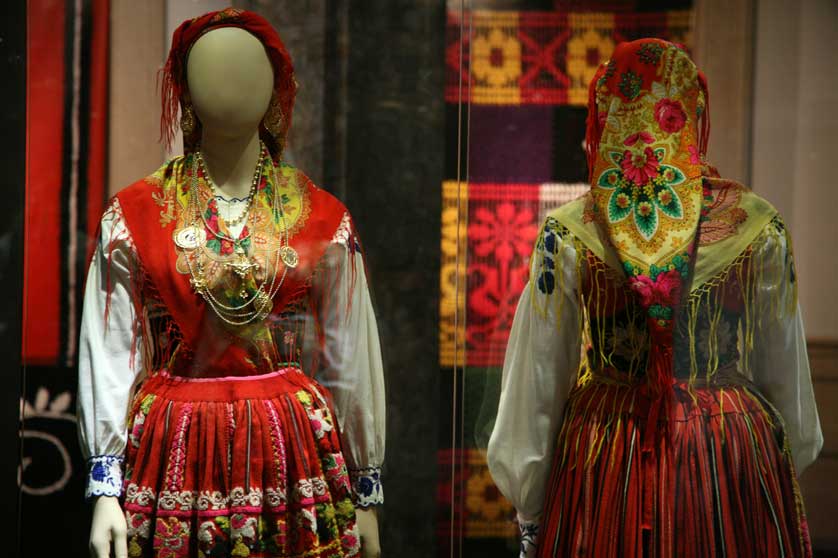
The costumes on display were traditionally made in the evenings by young women to be worn on special occasions and local festivals, in particular the annual Romaria de Nossa Senhora d'Agonía.
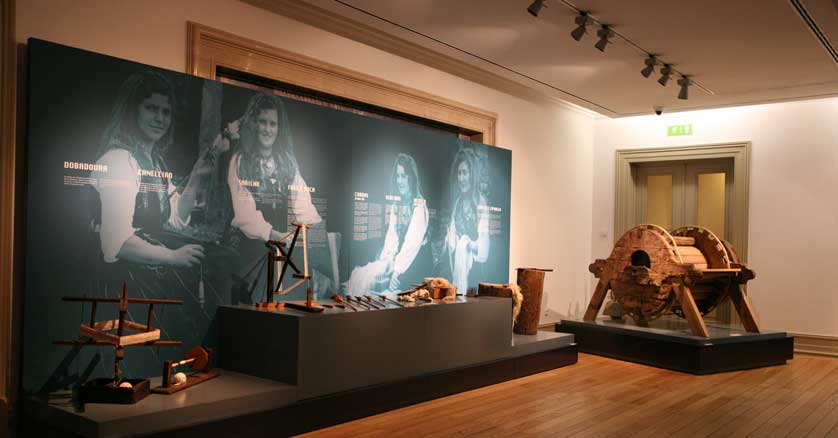
Women who might labour in the fields with flax and tend sheep to produce wool during the day would then work on the same materials in the evening using traditional, wooden looms which are also on display in the museum.
These rural villages around Viana do Castelo were virtually self-sufficient and the colorful costumes became a symbol of both local identity and pride.
The brighter colored costumes (Traje de Lavradeira) were usually worn by the younger women hoping to attract a future husband at a festival by showing off their dexterity and thus suitability as home-makers. The elaborate stitching could also include coded messages as to the wearer's age, family and locality.
A small, embroidered heart-shaped handbag, known as an algibeira, is carried with this costume.
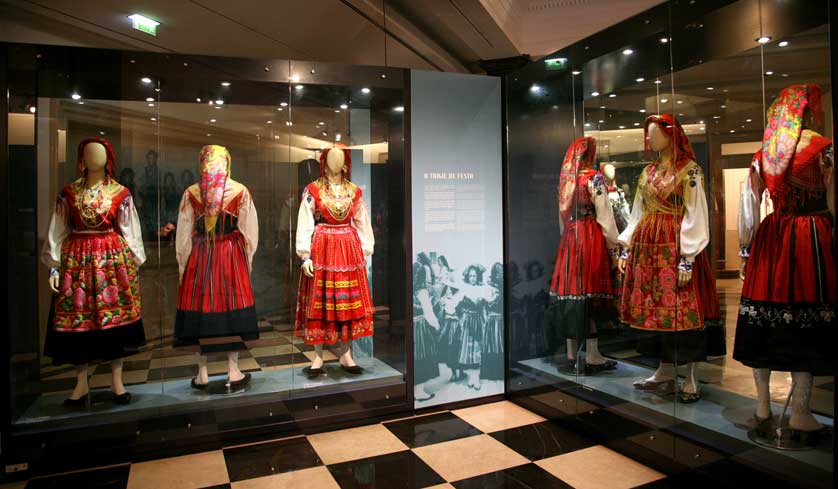
The darker dresses were traditionally worn by women known as mordoma. These women were chosen in a village to organize festivals and collect funds for pilgrimages. They held a special status in their communities. These darker dresses would become the girl's bridal gown and were often buried with her when she died. The costume typically included a short-breasted, heavily-ornamented waistcoat and velvet apron embroidered with glass beads.
The full outfit also included a silk head scarf or veil, lace socks and plain black or white canvas slippers.
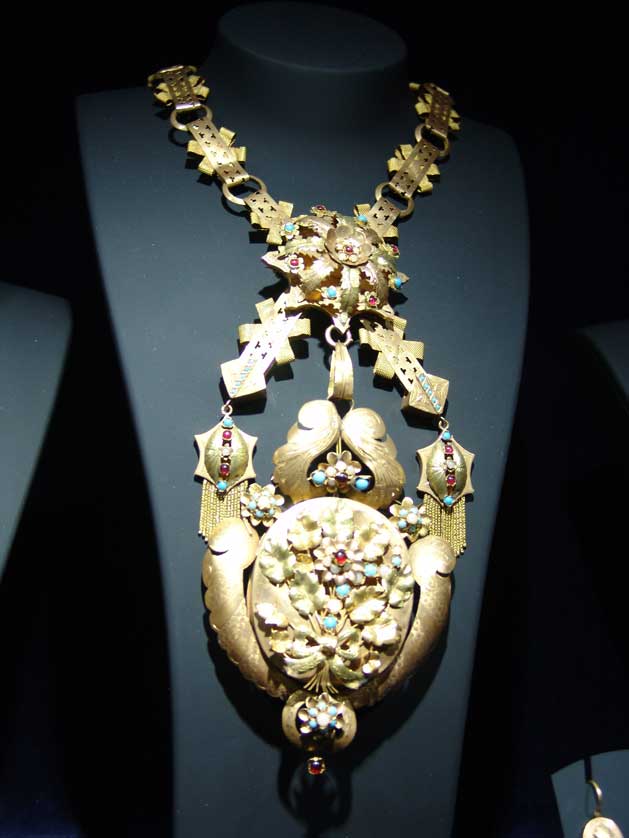
The women also wore finely-worked golden ornaments to display the economic status of her family. (See image below).
The darker costumes might also be worn in periods of mourning or when a loved one was away, typically at sea.

The costumes on display worn on mannequins in glass cases are explained by wall panels in Portuguese and English.
The second floor of the museum has displays of the wooden implements used to produce the materials. Here, in addition, are the plainer, woollen clothes worn to keep warm when the villagers collected seaweed (sargaço) to be used as fertilizer on their fields. This chore was often done by women but not exclusively.
As befitting a bank, the top floor now contains the old vault along with a collection of the golden ornaments used to adorn the colorful dresses of Lavradeira and Mordoma.
The museum has a small shop at the entrance selling pieces of embroidered stationary, greeting cards and the like.
No photography is allowed within the museum.


Access - Getting There
Costume Museum (Museu do Traje)
Praça da República
Viana do Castelo
Tel: 258 809 306
Admission: 2 Euros (discounts are available for students).
Hours: Tuesday - Friday 10 am - 6 pm; Saturday & Sunday 10 am - 1 pm; 2 pm - 6 pm.
From the north-south main street of Avenida dos Combatentes da Grande Guerra from Viana do Castelo Station turn east (left) into Praça da República.
Nearby at Rua Manuel Espregueira 37 is the popular Pastelaria Confeitaria Manuel Natário. The shop is famous for its Bolas de Berlim (custard-filled doughnuts) and you can often see a queue of locals outside.
www.cm-viana-castelo.pt (official website in Portuguese)