Images of Portugal: Equestrian statue of Dom João IV, Vila Viçosa
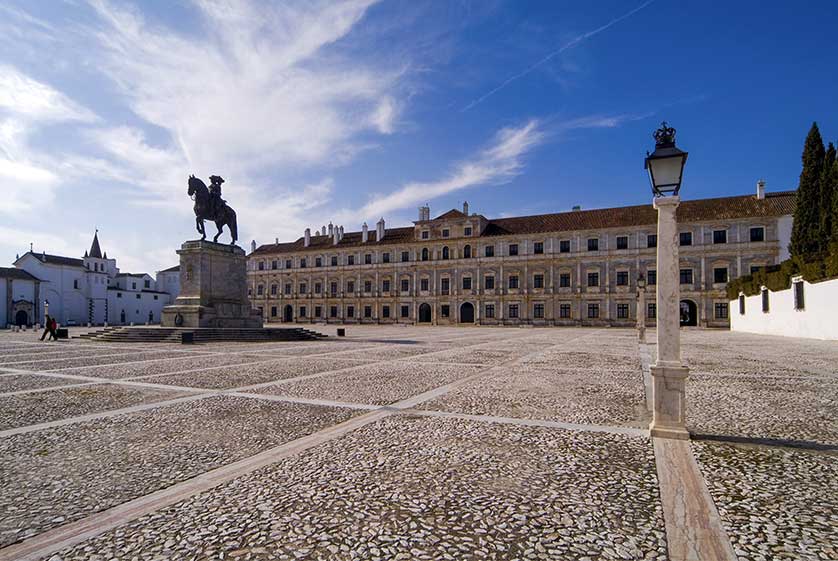
The Equestrian statue of Dom João IV in Vila Viçosa stands outside the impressive Ducal Palace (Paço Ducal de Vila Viçosa).
The palace is full of fine furniture, paintings and tableware from different centuries. The interior is beautifully worked with much use of local marble. Highlights of the Paço Ducal de Vila Viçosa include the Sala das Tapeçarias (Tapestry Hall) with its beautiful azulejos tiles, the Sala do Gigante (Hall of the Giant) with its fantasy frescoes and the Sala de Medusa (Hall of Medusa), with a painted fresco depicting the struggle between Medusa and Perseus. The armory has displays of arms and weapons belonging to the Dukes of Bragança and there are also collections of royal coaches and carriages, ceramics from both Portugal and China as well as hunting trophies from the Tapada Real (royal hunting grounds).

Dom João IV of Portugal, born João, Duke of Bragança (1604-1656), was a significant figure in Portuguese history. He played a crucial role in the Portuguese Restoration War (Guerra da Restauração), which resulted in the restoration of Portuguese independence from previous Spanish rule.
João was born into the House of Bragança, one of the most influential noble families in Portugal. His father was Dom Teodósio II, Duke of Bragança, and his mother was Ana de Velasco y Girón. The House of Bragança would subsequently become the ruling house of Portugal.
He married Luisa de Guzmán, a Spanish noblewoman, in 1633. They had several children, including Afonso VI, who would later succeed João as king.
In 1640, a revolt known as the Portuguese Restoration War broke out against Spanish rule. Portugal had been under Spanish control since 1580 when Philip II of Spain became Philip I of Portugal. The war aimed to restore Portuguese independence. On December 1, 1640, João, Duke of Bragança, was acclaimed as King João IV of Portugal, marking the beginning of the House of Braganza's reign.
After a series of battles and negotiations, the Treaty of Lisbon was signed in 1668, formally recognizing Portuguese independence and the end of the Portuguese Restoration War. This treaty was part of the broader Peace of Westphalia that concluded the Thirty Years' War.
João IV faced numerous challenges during his reign, including military conflicts, economic difficulties, and political instability. His reign was marked by efforts to consolidate Portuguese sovereignty and rebuild the nation after years of Spanish rule.
Despite the challenges, João IV was a patron of the arts, and his court became a center for cultural and artistic activities. He was particularly supportive of literature and music, and the period of his reign is associated with the "Seventeenth Century Renaissance" in Portugal.
João IV died on November 6, 1656. His son, Afonso VI, succeeded him. The House of Bragança continued to play a significant role in the history of the nation, eventually producing several monarchs and leading figures in the country

