Images of Portugal: The Igreja de Santa Maria da Feira, Beja
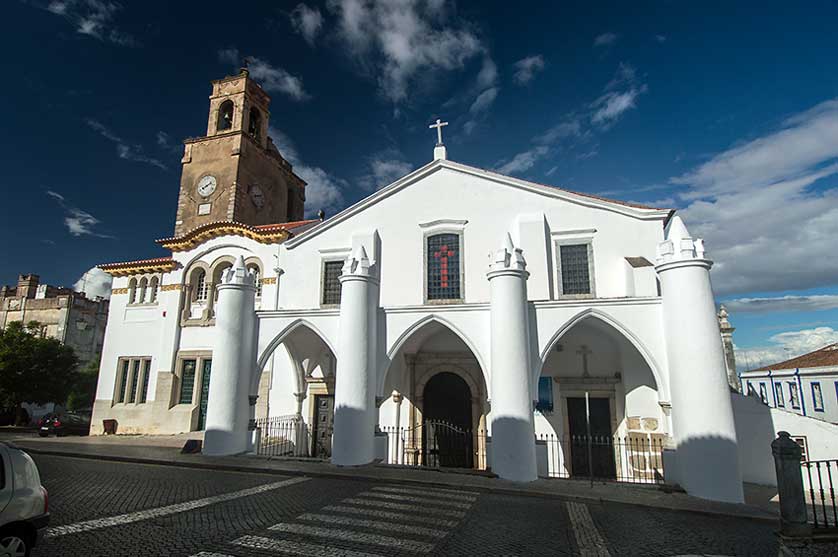
The Igreja de Santa Maria da Feira in Beja in the Alentejo region stands in Largo de Santa Maria in the center of town.
The origins of the church go back to the Visigothic period, possibly the 7th or 8th century. During the Muslim occupation of the Iberian peninsula, it was converted into a mosque.
In 1259 a new church was built dedicated to the Virgin Mary, on the initiative of Afonso III of Portugal. The parish became known as "Santa Maria da Feira" since, also by license from D. Afonso III, in 1261, the town's fair began to be held in the area around the church. In 1270 the temple was given to the Portuguese monastic military, the Order of Avis.
The building to the left of the church is the Caixa Geral de Depósitos which replaced the former chapel of Nossa Senhora do Rosário in 1922. It separates the church from the bell tower which contains a 14th century bell.
The body of the church was completely remodeled in the last quarter of the 16th century, which eliminated almost all of the temple's medieval features.
The interior has a longitudinal plan, with three naves of equal height covered with vaults and separated by cylindrical columns with Tuscan capitals. This architectural plan follows that of other late-Renaissance churches of the time, such as the Church of Santo Antão in Évora.
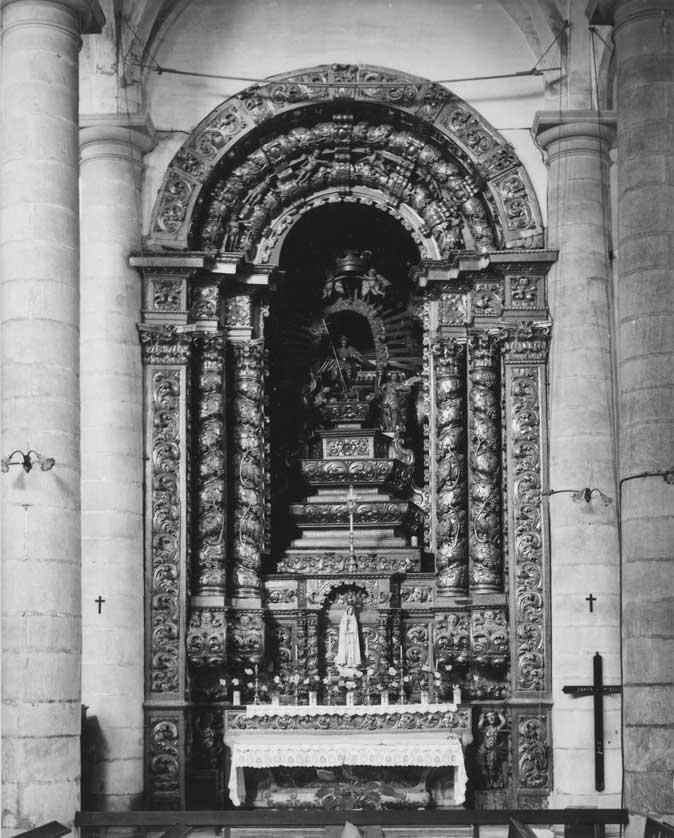
The wooden, neoclassical main altar (late 18th century), is austere. The gilded side altars date from the 17th and 18th centuries and are of great quality. Among these, the Chapel of Nossa Senhora do Rosário stands out, with carvings carried out between 1677 and 1681 by Manuel João da Fonseca with a monumental genealogical tree of Jesus Christ. Another important altar is that of the archangel São Miguel (Archangel Michael), made of polychrome carvings in the Baroque style. The Altar of the Blessed Sacrament, in polychrome marble in a neoclassical style, was made at the end of the 18th century and has a screen representing the Last Supper by Pedro Alexandrino de Carvalho.
