Guimarães Museums
The UNESCO World Heritage listed historic city of Guimarães has several excellent museums to visit.
The Guimarães Pass (15 Euros or 18 Euros with the Teleférico) offers reduced admission fees for several of the museums including the Museu da Cultura Castreja and the Citânia de Briteiros which are outside the city.
Museu de Alberto Sampaio
The Museu de Alberto Sampaio in Guimarães is located in heart of the city. The museum displays a wealth of historically significant as well as beautiful religious art and artifacts. The museum occupies the former 10th century monastery built by Countess Mumadona Dias, around which the city of Guimarães developed. The museum has a superb collection of religious art of over 2,000 pieces covering the medieval and Renaissance periods and extending until the 18th century. The jewelry collection is considered one of the best or the best in Portugal. Highlights include the Romanesque chalice of Dom Sancho I and an image of Santa Maria de Guimarães from the 13th century.


Convento de Santo António dos Capuchos
The Convento de Santo António dos Capuchos is a 17th century convent that was purchased in 1842 by the Santa Casa da Misericórdia do Porto. This was founded in 1498 by D. Manuel I and Queen Leonor and continues to provide public charity and social assistance to the people of Portugal into the modern era. The larger parts of the original building still function as a hospital. The part of the Convento de Santo António dos Capuchos open to visitors includes the beautiful 17th century sacristy, as well as several cloisters and courtyards. Also on display are religious paintings as well as frequent temporary collections of more contemporary art.
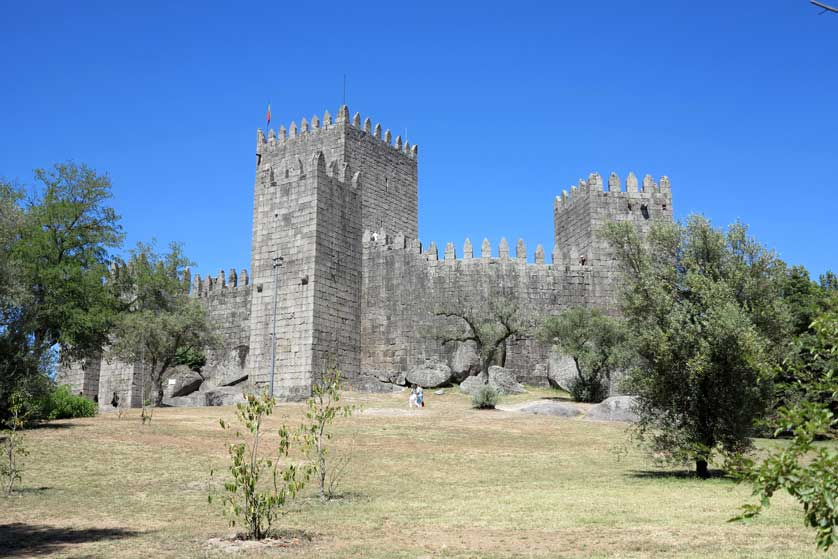

Guimarães Castle
Guimarães Castle is considered one of the finest castles in Portugal and is of particular importance in the history of Portugal. The original fortress on the site was constructed in the 10th century by Mumadona Dias, the widow of Count Hermenegildo Gonçalves. The castle was meant as a place of secure refuge both for the town's inhabitants and the monks and nuns of a monastery on the site of what is now the Igreja de Nossa Senhora da Oliveira. Guimarães' citizens needed a secure place to escape frequent raids by Vikings from the north and the Muslims from the south. However, the castle has changed much over the succeeding centuries.


Palace of the Dukes of Braganza
The Palace of the Dukes of Braganza was constructed on the orders of Afonso de Barcelos, an illegitimate son of King João I, in the early 15th century from about 1420. Afonso was later to become the first Duke of Braganza. Afonso's successors resided here until they moved to the much grander and larger Vila Viçosa Ducal Palace (Paço Ducal de Vila Viçosa) in Vila Viçosa near Elvas and Estremoz from the early 16th century onwards. The design of the Paço dos Duques de Bragança was based on French manor houses of the period. Between the 16th and 19th centuries the palace fell into semi-ruin and many of its building stones were taken away to be used for other purposes. During the Estado Novo period under Salazar, a reconstruction by the architect Rogério de Azevedo was completed between 1937 and 1959 which conferred a grandeur on the property which it probably never possessed. Indeed, it is believed the original building was not complete when the Duke decamped to Vila Viçosa.

Museu Arqueológico da Sociedade Martins Sarmento
The Museu Arqueológico da Sociedade Martins Sarmento is one of the oldest in Portugal dating back to 1885. It exhibits a wide collection of the thousands of pieces gathered during his lifetime by the renown archaeologist Martins Sarmento (1833-1899). The building is the former 14th century Gothic convent of São Domingos with the exhibits displayed both in interior galleries and outside in the convent's courtyards.
Centro Internacional das Artes José de Guimarães
The Centro Internacional das Artes José de Guimarães was part of the redevelopment of the Municipal Market by the Portuguese architectural firm, Pitágoras Arquitetos. The design won a number of domestic awards. The space opened in 2012 when Guimarães was the European Capital of Culture. The museum is named after locally-born artist José de Guimarães. His collections of African tribal art and other art works form part of the museum.
Palácio Vila Flor
The Palácio Vila Flor in Guimarães is an 18th century palace and garden. Adjacent is the modern Centro Cultural Vila Flor, which opened in 2005. The Centro Cultural Vila Flor has two auditoriums and is a venue for theatre and concerts, hosting both classical music and contemporary rock and pop. The Palácio Vila Flor was first built as a residence for the local aristocrat Tadeu Luís Fonseca e Camões in 1759.
Curtir Ciência Centro Ciência Viva de Guimarães
The Curtir Ciência Centro Ciência Viva de Guimarães (Live Science Center) in Guimarães is a fun science museum. It is located in an historic, former tannery in the Zona de Couros leather-making district of the city. Though primarily aimed at school children the museum is also of interest to adults.
Casa da Memória
The Casa da Memória is dedicated to preserving the history and culture of the city of Guimarães and its surrounding area from times past to the present day. The space (House of Memory) attempts to recreate a set of memories for citizens to understand the geographical and historical processes that created a set of memories shared by the community at large. The museum is located in a former Plastics Factory (Fábrica de Plásticos Pátria). Inside the museum visitors can see some of the products made at the factory: combs, hair pins, head bands, toys, etc. The former industrial site was converted in 2012 to the museum we see today by the architects Miguel Guedes and Carlos Melo Dias. This was part of the Guimarães European City of Culture 2012 project.
Museu da Cultura Castreja
The Museu da Cultura Castreja is an 18th century manor house that belonged to the family of Francisco Martins Sarmento, The archaeologist took up residence here during his work on the Citânia de Briteiros and Castelo de Sabroso sites. The museum contains finds from these excavations including Roman coins, pottery, metalwork and sculpture. The Pedra Formosa de Briteiros ("handsome or beautiful stone"), a large monolith, thought to be part of an ancient bath house or possibly burial chamber, is on display.

Citânia de Briteiros
Citânia de Briteiros, located north of Guimarães towards Braga, is a large pre-Roman settlement in Portugal that contained around 200 homes. It was also later settled by the Roman occupiers of the Iberian Peninsula. The settlement dates back to the Neolithic Period and there are several examples of rock art at the site. The settlement was a walled village or hill fort. There are visible remains of fountains, ramparts, roads, two bath houses and a large meeting hall.
Hotels
Hotels in Guimarães include the four star Santa Luzia ArtHotel, the four star EMAJ Boutique Hotel and the Hotel da Oliveira, also four star.
Other places to stay in the city include the four star Hotel de Guimarães and the pleasant Stay Hotel Guimarães Centro, adjacent to the railway station. The budget HI Hostel Guimarães - Pousada de Juventude is a cheaper option.

