Igreja de São Vicente de Fora
The Igreja de São Vicente de Fora also referred to as Mosteiro de São Vicente de Fora ("Monastery of St. Vincent Outside the Walls") is located in the Alfama district of Lisbon close to the Feira da Ladra (Thieves' Market) and the National Pantheon (aka Igreja de Santa Engrácia).

History
The original church was founded in the 12th century by King Afonso Henriques, for the Augustinian Order and takes its name from its original location outside (fora) the city walls.
It was here that the king established his camp during the siege of Lisbon.
The first Igreja de São Vicente de Fora was dedicated to the patron saint of Lisbon, Saint Vincent of Saragossa, whose bones were interred in the church long after his death and kept as relics. Vincent was martyred under the Roman Emperor Diocletian in 304 after supposedly horrendous torture.
The present building dates from the rule of King Philip II of Spain over Portugal from 1580. The monastery church was thought to have been principally designed by the Italian-born architect, Filipe Terzio and constructed between 1582 and 1629 with other buildings added up until the 18th century. The buildings were much damaged in the 1755 earthquake and subsequently repaired.
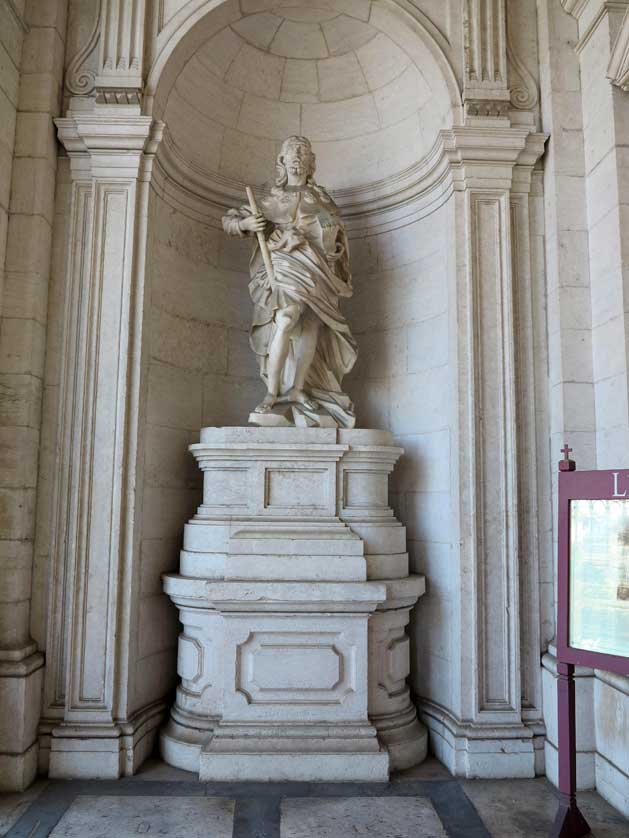
The façade of the church is built in the architectural style known as Mannerism with two towers flanking niches holding statues of saints.
The interior of the church has a barrel vaulted ceiling with a Baroque altar by the Portuguese sculptor Joaquim Machado de Castro (1731-1822).
Post-1834 when the religious orders were dissolved in Portugal, the previous monks' refectory was transformed into a pantheon for the kings and queens of the House of Braganza (Bragança). The tombs of monarchs from João IV to the last Portuguese monarch Manuel II can be seen.
Other highlights of Mosteiro de São Vicente de Fora include the superb blue and white azulejos tiles showing scenes from Portuguese history in the entrance portal to the monastery buildings and the superb marble of the sacristry. The cloister contain tiles depicting the fables of the French writer Jean de La Fontaine.
In a small chapel off the nave there is a small memorial plaque to Henry of Bonn, a German knight who died taking the city from the Moors. During the Medieval period a cult arose around him after a tree supposedly sprouted from his tomb.
The roof has wonderful views of the Alfama district and out over the River Tagus to the south.

Access
The Mosteiro de São Vicente de Fora is fairly close to Santa Apolonia Station which is on the blue line of the Lisbon metro. Alternatively take tram #28 or a #734 Lisbon bus which runs from the Martim Moniz metro station to Santa Apolonia Station via Campo Santa Clara.
Mosteiro de São Vicente de Fora
Largo de São Vicente
1100-572, Lisbon
Tel: + 351 21 882 4400
Hours: 10 am - 5 pm; closed Monday
Admission: a fee is charged to enter the monastery buildings, the church is free.
The National Pantheon is close to the Igreja de São Vicente de Fora and the Feira da Ladra (Thieves' Market) held on Tuesdays and Saturdays in the Campo de Santa Clara and surrounding streets.


Book Air Tickets to Spain & Portugal
Cheap flights from Europe with low cost carriers