Penha & The Teleférico de Guimarães
The small mountain of Penha, 7 km southeast of Guimarães, is a popular retreat from the city and is still an active place of modern pilgrimage.

History
Penha as a place of pilgrimage goes back only relatively recently to the late 19th century. However, before that the mountain was the home for a French hermit, William Marino, who found shelter and retreat in one of the area's many caves and grottoes.
His placing of a statue of the Virgin Mary he had made in Braga in the 11th century is said to be the start here of the devotion to Our Lady of Mount Carmel (Nossa Senhora do Carmo).
In the 18th century a group of Discalced Carmelites lived on and around the spot where the hermit once secluded himself.
Various sites are associated with these later hermits such as the Hermit's Cellar, the Grotto of Our Lady of Mt. Carmel, the Grotto of Father Caldas, the Chapel of St. Christopher, the Hanging Rock and the Suspended Garden. They can all be seen on a walk around the area.
In the mid-19th century interest was rekindled in Penha and an association was established to build a more permanent place of worship on the mountain top.
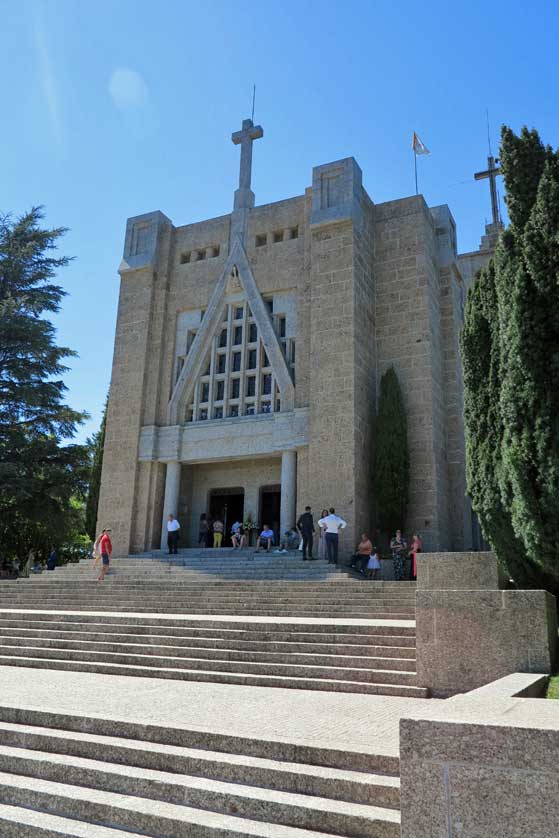
As a result, it was decided to construct the Santuário da Penha, which was to be dedicated to Nossa Senhora do Carmo de Penha. However, work was not begun until as late as 1930 and was not completed until 1947.
The church is the work of the Porto-based architect José Marques da Silva (1869-1947) who also designed São Bento Station, the São João National Theatre and the Serralves House and Gardens all in his home city.
The tile panels within the church are by Policarpio de Oliveira Bernardes (1695 - 1778) and were moved there from another location.
Attractions
There are great views over the city from Penha, parkland to picnic in, bicycle and walking trails, restaurants and cafes, mini-golf and places to stay.
Walkers can admire some huge, moss-covered boulders at the summit.
The church is also a popular place for couples to get married and for christenings.
On the second Sunday in September there is also a pilgrimage to the top led by marching bands.
Places to eat and drink at Penha are many and the choice includes the Adega do Ermitão, Restaurante Dan José, Restaurante Montanha, Cafe Penha, Bar Natureza and the Casa das Merendas.
Among the wildlife that inhabits this 60 hectares of green space are various types of birds, wild boar, foxes, squirrels and rabbits.
The flora consists of several different species of plants and trees: birch, cedar, chestnut, cork oak, cypress, fig, fir, olive, pine, plane and walnut.


Access
Visitors take the cable car (Teleférico de Guimarães) over 1,500 meters up to the Penha hilltop at 617 meters.
The Teleférico de Guimarães is considered to be the first cable car in Portugal.
You can also walk to the top of course. By car take the N101-2 from the Convento de Santa Marinha da Costa and the Pousada Mosteiro de Guimarães. The M-579-2 approaches Penha from the south east.
Buy a ticket at the lower station or the return trip is included in the Guimarães Pass + Cable Car option.
The cable car runs from 10 am - 7 pm daily and from 10 am until 5.30 pm on Friday, Saturday and Sunday during the winter (November-March). Closed 25 December.
In 2020 the price was 7.50 Euros for a return trip for adults and 4 Euros for holders of the Cartão Jovem (European Youth Card) for people aged 12-29.
There are also local TUG buses to the lower station of the cable car. Take the 51/52 Circular.

Nearby
Things to see in this UNESCO World Heritage city include Guimarães Castle, the Church of São Miguel do Castelo and the Palace of the Dukes of Braganza (Paço dos Duques de Bragança).
Other attractions in include the Alberto Sampaio Museum and the Padrão do Salado, built in the 14th century to celebrate a famous victory over the Moors by combined Spanish and Portuguese armies. It stands just outside the Igreja de Nossa Senhora da Oliveira.
Hotels
Hotels in Guimarães include the four star Santa Luzia ArtHotel, the four star EMAJ Boutique Hotel and the Hotel do Carmo, also four star.
Other hotels in Guimarães are the four star Hotel de Guimarães and the pleasant Stay Hotel Guimarães Centro, adjacent to Guimarães Station. The budget HI Hostel Guimarães - Pousada de Juventude is also in this area.
