Almost every first trip to Portugal includes the same journey. You start in Lisbon, with its trams, miradouros and pastéis de nata, and at some point you head north to Porto for the Ribeira, the port lodges and the Douro.
The two cities are about 300 km apart, and there is no single best way to cover that distance. The fastest option on paper isn't always the easiest in practice, and the cheapest one can cost you half a day if it doesn't suit your plans.
This guide compares the four realistic options (train, bus, car and private transfer) and explains which one fits which kind of trip.
The options at a glance
|
Option |
Journey time |
Rough cost |
Best for |
|
Train (Alfa Pendular) |
About 2 h 45 min to 3 h |
Mid-range, cheaper if booked early |
Most travellers going city to city |
|
Train (Intercidades) |
About 3 h 15 min |
A little less than Alfa Pendular |
Budget travellers who still want rail |
|
Bus |
About 3 h 15 min to 3 h 45 min |
Usually the cheapest |
Tight budgets, flexible plans |
|
Car |
About 3 h direct |
Rental, fuel, tolls and often a one-way fee |
Road trips with stops |
|
Private transfer |
About 3 h direct |
Highest per person, closer for groups |
Luggage, families, door to door, stops on the way |
Times are typical and fares change with demand, so check current prices before you book.
By train: the default choice for most people
The train is the most popular way to travel between the two cities, and for good reason. CP, Portugal's national rail operator, runs two main services on the route.
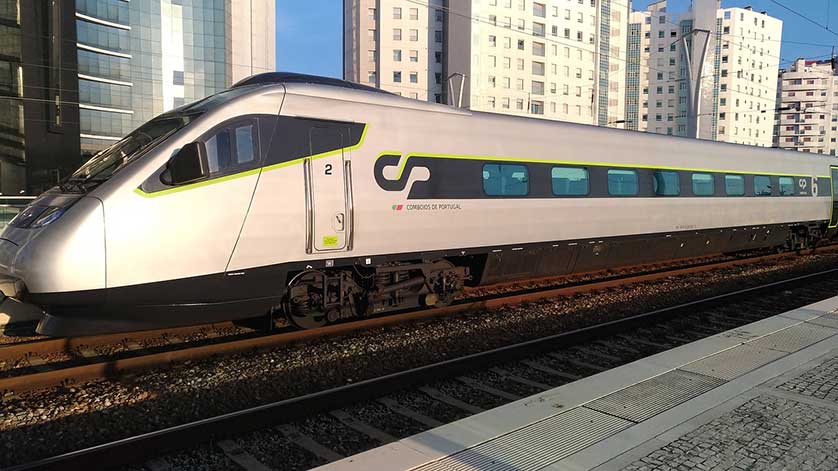
Alfa Pendular is the faster tilting train, taking around 2 hours 45 minutes to 3 hours. It has assigned seats, power sockets and a café car, plus a more comfortable first-class carriage.
Intercidades makes a few more stops and takes roughly 3 hours 15 minutes. It's a little cheaper and perfectly comfortable.
In Lisbon, trains leave from Santa Apolónia, close to Alfama and the riverfront, and stop at Oriente in the Parque das Nações area. In Porto, they arrive at Campanhã, which is a little outside the historic centre. If you're staying near the Ribeira or Avenida dos Aliados, you'll need a short connecting train to São Bento, a taxi or the metro.
Tips:
- Book on the CP website or app as soon as your dates are fixed. Discounted fares go quickly on popular days.
- Seats are assigned, so check your carriage number before boarding.
- Friday afternoons and Sunday evenings are the busiest times. Travel mid-morning or midweek if you can.
- Luggage racks fill up fast, so board early if you have large suitcases.
By bus: the budget option
Rede Expressos and FlixBus both run frequent coaches between Lisbon and Porto. The journey usually takes 3 hours 15 minutes to 3 hours 45 minutes, depending on traffic and stops.
The main draw is price. Bought in advance, a bus ticket often costs a fraction of the train fare, which makes a real difference for solo travellers and backpackers.
The trade-off is comfort and convenience. In Lisbon, most coaches leave from Sete Rios or Oriente, and in Porto they arrive at terminals away from the old town. Traffic on the A1 can also add time, especially on Friday evenings and at the start of holiday weekends. If you're carrying a lot of luggage, the transfers at either end can be the most tiring part of the day.
By car: freedom, with a few hidden costs
Driving direct on the A1 motorway takes about three hours. The road is good, well signposted and easy to follow.
The real reason to drive is everything in between. Central Portugal is full of places that are hard to reach by public transport: the walled town of Óbidos, the surf beaches of Nazaré, the monasteries at Alcobaça and Batalha, the university city of Coimbra and the canals of Aveiro. With a car, the trip becomes a two-day road trip instead of a transit day.
Before you book, factor in the extras:
- Tolls. The A1 is a toll motorway, and the full Lisbon–Porto run adds a noticeable amount to the cost. Ask your rental company about an electronic toll device, since some Portuguese motorways have no toll booths at all.
- One-way fees. Picking up in Lisbon and dropping off in Porto often comes with a one-way charge.
- City driving and parking. Both cities have narrow, steep historic centres and limited parking. Many visitors return the car before exploring Porto on foot.
By private transfer: door to door, with stops if you want them
A private transfer is the most expensive option for a solo traveller. For families and small groups, the gap narrows quickly once you add up several train tickets and the taxis at both ends.
What you're paying for is simplicity. The driver collects you from your Lisbon hotel and drops you at your Porto accommodation, with no station transfers, no luggage on stairs and no need to find parking. The direct drive takes around three hours.
Many travellers use a transfer to combine the journey with sightseeing, adding a stop in Óbidos, Coimbra or Fátima without renting a car. It also works well for travellers with mobility needs, young children or a lot of luggage.
If you're weighing this against the train or a rental car, this guide on getting from Lisbon to Porto breaks down times, prices and station details for each option side by side. Whichever operator you choose, confirm whether the price includes tolls and waiting time, and agree on any stops in advance.
What about flying?
There are domestic flights between Lisbon and Porto, and the time in the air is under an hour. Once you add the trip to the airport, security, boarding and the ride into Porto, though, it rarely beats the train door to door.
Flying makes sense mainly if you're connecting to or from an international flight at either airport. For a simple city-to-city trip, rail or road is usually faster and less hassle.
Which one is right for you?
Take the train if you're travelling light, staying near a station and want the best balance of speed, comfort and price. For most visitors, this is the answer.
Take the bus if budget comes first and you don't mind a slightly longer, less comfortable ride.
Drive if you want to see central Portugal properly and have two or three days for the journey. The stops are the reason to rent the car.
Book a private transfer if you're a family or group, have heavy luggage, are staying somewhere awkward to reach from the stations, or want one or two stops without the hassle of renting and returning a car.
There's no wrong choice here. It depends on whether you want the journey to be quick, cheap or part of the trip itself.
The bottom line
Lisbon and Porto are close enough that any of these options will get you there comfortably in about three hours. Decide what matters most on the day (cost, speed, luggage or the places in between) and book that option early.
Then you can stop thinking about the journey and start planning your first glass of port by the Douro.