Synagogue of Tomar
The Synagogue of Tomar (Sinagoga de Tomar) is a historic building in the town of Tomar, famous for the UNESCO World Heritage Listed Convento de Cristo.
The building is also known as the Museu Luso-Hebraico Abraão Zacuto, after the famous Jewish astronomer, Abraham Zacuto (1452-1515?), who made navigational tools for the explorer Vasco da Gama, and for a time served as Royal Astronomer to King John II of Portugal.
The synagogue was the heart of the medieval Jewish community and served as a place of worship, court, school and assembly.

History
The Synagogue of Tomar is believed to be the oldest preserved synagogue in Portugal and was built sometime between 1430-1460.
The building served as a place of worship for the town's Jewish community only until 1496 when the rising tide of anti-Semitism on the Iberian Peninsula meant that Jews in Portugal were given an ultimatum to either convert to Christianity as "New Christians" (cristãos-novos) or leave the country entirely. Zacuto was one prominent Jew who managed to flee to Syria.
Some Jews, despite having being baptized, continued to secretly practice their original faith and were known as the Marranos - a pejorative term that can also mean "swine." Crypto-Jewish communities continued to exist, especially in northeastern Portugal in Belmonte near Guarda, Bragança, Chaves and Miranda.


National Monument
Over the following centuries the Synagogue of Tomar had various uses after it had to be given up: as a prison, chapel and grocery store and warehouse.
In the 1920's research by Portuguese archaeologists established the importance of the building and in 1921 it was classified as a national monument. It was purchased by Samuel Schwarz, a Polish Jew who donated the building to the Portuguese government so that a museum could be established in 1939.
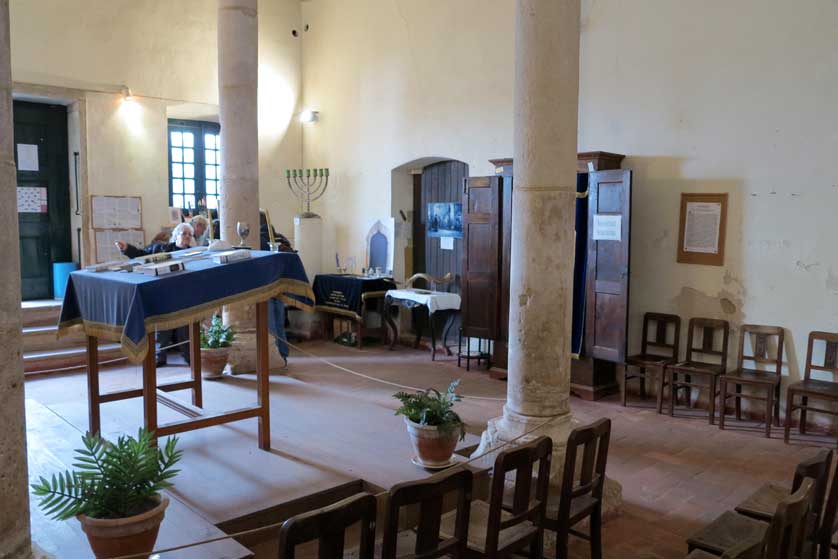
Nowadays, the Synagogue of Tomar has been restored. The square building has Gothic vaults supported by four pillars with eight upturned clay jars in the corners acting as primitive amplifiers.
Various Hebrew symbols on the walls have symbolic meaning as do the 12 corbels (supporting brackets) which represent the 12 tribes of Israel. The four columns represent the four matriarchs of Israel: Sarah, Rebecca, Leah and Rachel.

After some excavations at the site, a rectangular room was found, adjoining the main building, for the mikvah, the ritual bath of purification of Jewish men and women.
Exhibits
The museum's collection includes books and articles on Jewish tradition and worship. Some tombstones from various parts of the country have been collected at the museum and attest to the importance of Jewish culture in Portugal. These include a funeral stele from Faro, alluding to the death in 1315 of Rabbi Joseph of Tomar, and a tombstone of 1308, which marks the founding of the second synagogue in Lisbon.

Access & Hours
Synagogue of Tomar Porto
73 Rua Dr. Joaquim Jaquinto, 2300-577 Tomar
Hours: May - September; Tuesday-Sunday; 10 am - 1 pm; 2 pm-6 pm
October - April Tuesday-Sunday; 10 am - 1 pm; 2 pm-5 pm
Admission: Free; (donations accepted)
Another interesting museum in Tomar is the unusual Museu dos Fósforos or Matchbox Museum close to Tomar train station and adjacent bus station.
Book Air Tickets to Spain & Portugal
Cheap flights from Europe with low cost carriers