Panteão Nacional / Igreja de Santa Engrácia
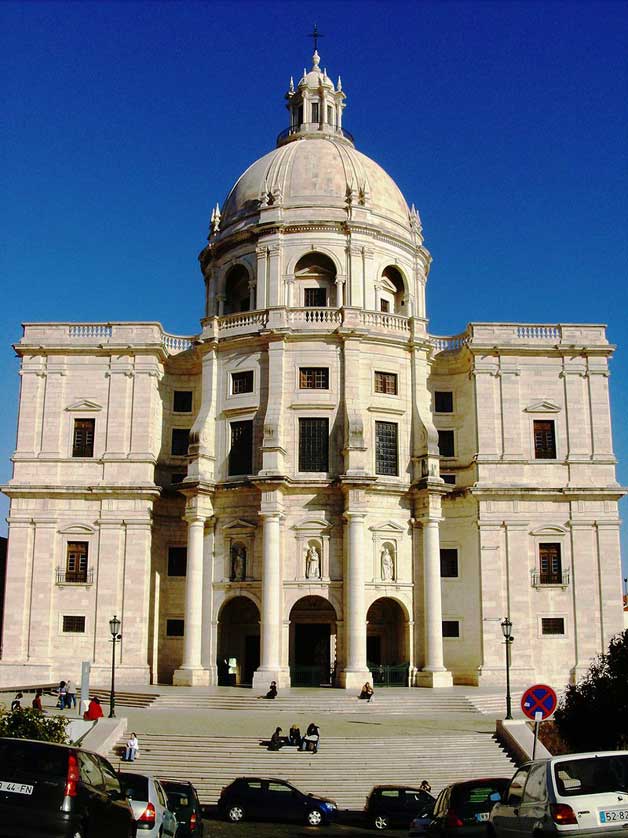
Located in the Alfama district of the Portuguese capital, the 17th century Igreja de Santa Engrácia has been converted in to the National Pantheon (Panteão Nacional) since the 20th century and holds the tombs of various famous Portuguese figures.
History
The original church was founded in the latter half of the 16th century but was later completely reconstructed at the end of the 17th century by architect João Antunes (1642-1712), famous for his Baroque designs. The church was never actually used as a place of worship as it remained unfinished after the architect's death.
The building is noted for its large dome (completed only in the 20th century) which is a popular landmark on the Lisbon skyline overlooking the historic centre of Lisbon and the Tagus River.
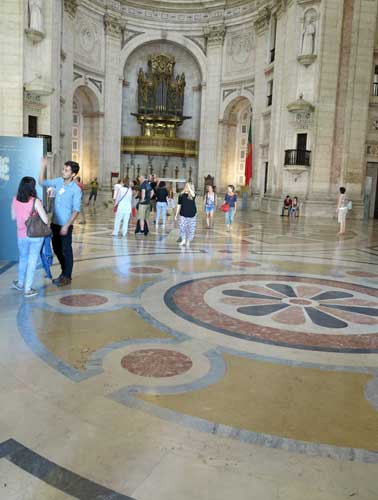
The spacious interior makes use of much marble elegantly finished in the Italian style. The terrace around the dome has spectacular views out over Lisbon.
The Igreja de Santa Engrácia became the Panteão Nacional in 1916 but was not completed until 1966 under the Salazar regime. The delay became a byword in Portugal for a long, unfinished project - Obras de Santa Engrácia.
Famous Portuguese people buried in the the Panteão Nacional include various Presidents of the Republic: Manuel de Arriaga (1840-1917), Teófilo Braga (1843-1924), Óscar Carmona (1869-1951) and Sidónio Pais (1872-1918). Also interred here are Humberto Delgado (1906-1965), a former right-wing general who later tried to overthrow the dictatorship of the New State before he was murdered, writers João de Deus (1830-1896), Almeida Garrett (1799-1854), Guerra Junqueiro (1850-1923), Aquilino Ribeiro (1885-1963) and Sophia de Mello Breyner Andresen (1919-2004), Amália Rodrigues (1799-1854), the fado singer, and Benfica soccer legend Eusébio (1942-2014).
Cenotaphs commemorate other Portuguese luminaries: Afonso de Albuquerque (c. 1453-1515), Pedro Álvares Cabral (c. 1467-1520), Luís de Camões (c. 1524-1580), Nuno Álvares Pereira (1360-1431), Vasco da Gama (c. 1460-1524) and Henry the Navigator (1394-1460).


Access
The Panteão Nacional is a short walk uphill from Santa Apolonia Station which is on the blue line of the Lisbon metro. Alternatively take tram #28 or a Lisbon bus any of numbers: 712, 734, 735, 704, 745, 759, 781 or 782 (to Santa Apolonia).
Panteão Nacional/ Igreja de Santa Engrácia
Campo de Santa Clara
1100 - 471 Lisbon
Tel: + 351 218 854 820
Hours: 10 am - 5 pm; closed Monday
Admission: a fee is charged to enter the building.
The National Pantheon is close to the Igreja de São Vicente de Fora and the Feira da Ladra (Thieves' Market) held on Tuesdays and Saturdays in the Campo de Santa Clara and surrounding streets.
Read more about Lisbon's churches.

Book Air Tickets to Spain & Portugal
Cheap flights from Europe with low cost carriers
